Mastering Google Ads AI for Better ROI, Lower CPC, and Higher Conversion Rates
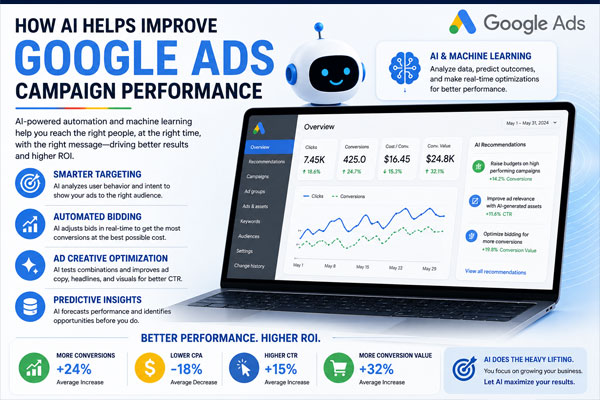
Google Ads has transformed from a platform where humans manually set bids to one where AI drives campaign decisions. Performance Max, Smart Bidding, responsive search ads, and audience signals are all powered by machine learning. Understanding how to leverage these AI-driven features is essential for modern digital marketers.
How AI Powers Modern Google Ads Campaigns
Smart Bidding Strategies
AI analyzes thousands of signals to automatically adjust your bids for maximum ROI. Smart Bidding options include: • Target CPA (Cost Per Acquisition): AI adjusts bids to achieve your target cost per conversion • Target ROAS (Return on Ad Spend): AI optimizes for a specific return multiple • Maximize Conversions: AI maximizes conversions within your budget • Enhanced CPC: AI increases or decreases bids based on conversion likelihood
Performance Max Campaigns
Performance Max is Google’s most AI-driven campaign type. It uses AI to: • Optimize across all Google channels (Search, Display, YouTube, Gmail, Maps) • Automatically generate ad variations • Test different audience combinations • Allocate budget across channels for best performance
Responsive Search Ads
Instead of creating fixed ads, responsive search ads let AI: • Test different headline and description combinations • Learn which combinations drive higher CTR • Show the most effective variations to different users • Continuously improve ad performance automatically
Audience Signals
AI-powered audience signals allow you to: • Provide audience insights without relying on tracking • Let AI find similar users automatically • Improve targeting precision while respecting privacy • Scale campaigns to interested users effectively
5 Strategies to Maximize AI Performance in Google Ads
Strategy 1: Implement Conversion Tracking
AI needs data to work effectively. Set up comprehensive conversion tracking for: • Form submissions • Purchase completions • Phone calls • App installations • Website interactions The more conversion data AI has, the better it can optimize.
Strategy 2: Give AI Sufficient Data and Time
AI learning requires a minimum amount of data. Provide: • At least 30 conversions per month for Smart Bidding to work effectively • 2-4 weeks of data before expecting optimal results • Consistent budgets so AI can learn patterns • Patience before making major changes
Strategy 3: Use Performance Max for Maximum AI Benefit
Performance Max campaigns unlock AI’s full potential across Google’s entire network. This is Google’s recommendation for most businesses because: • AI optimizes across channels you might not reach manually • Budget allocation is completely automated • Ad creation is streamlined • Results typically outperform traditional campaign types
Strategy 4: Provide Rich Creative Assets
The more assets you provide, the more options AI has to work with. Include: • Multiple headlines and descriptions • High-quality images and videos • Different ad sizes and formats • Clear landing pages for different audiences • Engaging call-to-action options
Strategy 5: Monitor Key Metrics Regularly
While AI handles optimization, you should monitor: • Cost per conversion trend • Conversion rate changes • Quality Score improvements • Click-through rate variations • Return on ad spend (ROAS)
How AI Helps Reduce Your Cost Per Lead
| Optimization Method | How AI Reduces Cost | Expected CPL Reduction |
|---|---|---|
| Smart Bidding | Focuses ad spend on high-intent clicks and likely conversions | 15%–25% reduction |
| Responsive Search Ads | Tests multiple headline and description combinations for better CTR | 10%–20% improvement |
| Performance Max | Optimizes campaign performance across all Google advertising channels | 20%–40% improvement |
| Audience Signals | Identifies users similar to existing high-intent customers | 5%–15% improvement |
FAQ: AI in Google Ads
If you have sufficient conversion volume and data, yes. Performance Max campaigns with Smart Bidding typically outperform manual strategies. However, some specialized campaigns might still benefit from manual optimization.
No. AI handles bid optimization and ad testing, but human strategists are needed for overall campaign strategy, audience insights, and creative direction. The best approach combines AI automation with human expertise.
Google recommends at least 15-30 conversions per month for Smart Bidding. If you have fewer conversions, consider manual CPC bidding until your volume increases.
Conclusion: Embrace AI for Better Google Ads Results
Google Ads AI is powerful and continuously improving. By understanding how these AI features work and implementing best practices, you can reduce your cost per lead, improve conversion rates, and achieve better ROI on your advertising spend. The future of paid search belongs to those who effectively leverage AI.
Optimize Your Google Ads with AI
Kaival Infotech provides comprehensive Google Ads Management Services in Ahmedabad, specializing in AI-driven campaign optimization. Whether you’re looking to reduce CPC, improve ROAS, or generate more qualified leads, our expert team can help. We specialize in Performance Max campaigns, Smart Bidding strategies, and conversion rate optimization. Contact Kaival Infotech today for a free Google Ads audit.
Related Posts
AI and WordPress: How Businesses Can Use Smart Automation
A Practical Guide to Implementing AI Automation on Your WordPress Website WordPress powers over 40%…
How Google AI Overviews Affect Website Traffic and Leads
Understanding the Impact of AI-Generated Search Results on Your Website's Performance Google AI Overviews are…
How to Optimize Your Website for ChatGPT, Gemini, and Google AI Search
A Comprehensive Guide to AI Search Engine Optimization (AEO) in 2024 AI-powered search engines are…