
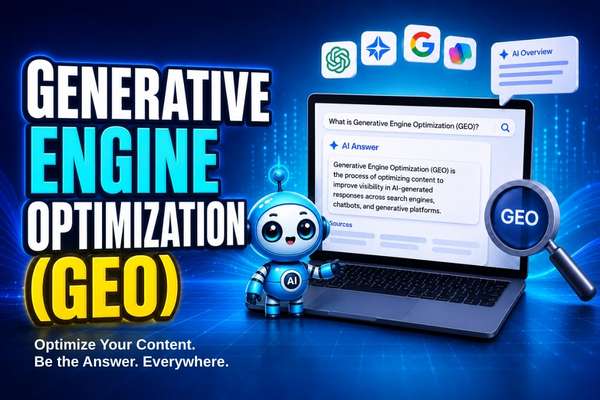
Generative Engine Optimization (GEO): The 2026 Playbook for Indian Businesses
For the last two decades, Indian businesses have relied on a singular digital playbook: optimize for Google’s blue links, capture clicks, and convert traffic. But as we navigate through 2026, the search box is no longer just a directory – it is a real-time synthesizer. Generative Engine Optimization (GEO) is officially the new SEO.
If you are a marketing leader or an SEO professional in India, you are witnessing the most aggressive shift in consumer behavior since the smartphone revolution. Millions of Indian users – from corporate procurement managers in Mumbai to industrial engineers in Ahmedabad – are bypassing traditional search results entirely. They are turning to ChatGPT, Google’s AI Overviews, Perplexity, and Claude for immediate, cited answers.
When an international client asks a generative engine, “Which Indian suppliers offer the best industrial water solution services?” the AI does not provide a list of ten websites. It writes a comprehensive answer, citing one or two highly optimized sources as the definitive truth. If your brand is not one of those cited sources, you have been erased from the modern buyer’s journey.
Indian businesses must act now. The algorithms powering Large Language Models (LLMs) operate on entirely different paradigms than traditional web crawlers. They demand a profound shift in how we structure data, deploy technical schema, and build multi-channel authority.
In this definitive, 3,000+ word playbook, you will learn the exact mechanics of Generative Engine Optimization. We will break down the groundbreaking Princeton University GEO research, detail the 9 proven optimization techniques, explore multilingual and local SEO adaptations specific to the Indian market, and provide the technical code necessary to future-proof your digital presence.
WHAT IS GENERATIVE ENGINE OPTIMIZATION (GEO)?
Generative Engine Optimization (GEO) is the systematic process of enhancing digital content so that it is easily understood, retrieved, and prominently cited by generative artificial intelligence models (such as ChatGPT, Gemini, and Perplexity) during the generation of conversational answers.
The formalization of GEO originated from a landmark research paper published by researchers at Princeton University, Georgia Tech, and the Allen Institute for AI. The researchers conducted massive empirical studies to determine what specific content modifications forced LLMs to cite a specific webpage over its competitors. Their research concluded that traditional SEO tactics (like exact-match keyword stuffing) had a negligible or even negative impact on AI visibility. Instead, they identified 9 specific content modifications – ranging from adding statistics to deploying highly technical terminology – that improved citation rates by up to 40%.
Traditional SEO vs. Generative Engine Optimization
To succeed in 2026, marketing leaders must understand the fundamental differences between optimizing for an algorithm that indexes links and optimizing for an algorithm that reads and synthesizes information.
| Feature | Traditional SEO | Generative Engine Optimization (GEO) |
|---|---|---|
| Primary Goal | Rank #1 to generate organic clicks to a website. | Be cited as the authoritative source in an AI’s conversational response. |
| Core Metric | Click-Through Rate (CTR) and Keyword Ranking. | Share of Model Voice (SMV) and Citation Frequency. |
| Content Focus | Targeting specific search volume keywords. | Answering complex, multi-layered conversational prompts. |
| Ranking Level | Page-level ranking (the whole URL must rank). | Passage-level ranking (a single paragraph can be extracted and cited). |
| Technical Focus | Core Web Vitals, Backlinks, Meta Tags. | JSON-LD Schema, Entity Mapping, Data Structuring. |
| User Journey | Search → Click → Read → Convert. | Prompt → Read AI Summary → Trust Cited Brand → Convert. |
Why GEO Matters for India in 2026
India is one of the fastest-growing markets for generative AI adoption. From Tier-1 cities to rapidly expanding industrial hubs in Gujarat and Maharashtra, B2B buyers are using AI to evaluate vendors, audit technical specifications, and generate shortlists. If an AI engine cannot easily parse your website’s unstructured data, it will ignore you in favor of a competitor whose content is formatted for machine comprehension. GEO is no longer a futuristic concept; it is the baseline requirement for digital survival.
Learn more about our foundational SEO and technical marketing strategies here.
HOW GENERATIVE ENGINES WORK
To optimize for an AI, you must understand its internal mechanics. Modern AI search engines do not just rely on the static data they were trained on. They use a dynamic framework called Retrieval-Augmented Generation (RAG).
The Mechanics of RAG
To optimize for an AI, you must understand its internal mechanics. Modern AI search engines do not just rely on the static data they were trained on. They use a dynamic framework called Retrieval-Augmented Generation (RAG).
Query Formulation: The AI translates the user’s conversational prompt into a search query.
Retrieval: The AI pings a live search index (like Google’s index or Bing’s index for ChatGPT) and retrieves the top-ranking documents.
Comprehension & Synthesis: The AI “reads” these documents in milliseconds, extracting the most relevant passages (not the whole page).
Generation: The AI writes a custom response based on the extracted passages, appending citations to the sources it found most credible.
Passage-Level vs. Page-Level Ranking
In traditional SEO, if your page was mostly about “apples,” it was hard to rank for “oranges,” even if you had one great paragraph about oranges.
Generative engines operate on passage-level retrieval. An AI model like Claude or Gemini can extract a highly technical, three-sentence paragraph about chemical packaging regulations from deep within a 5,000-word document and feature it prominently in a summary. This means every individual passage on your website must be factually dense, clearly written, and technically accurate.
The Role of Citations and Sources
LLMs are programmed to avoid hallucinations. To ensure accuracy, their alignment training forces them to rely on hard data, verifiable statistics, and authoritative external links. If your content provides these elements wrapped in clean HTML and JSON-LD schema, the AI treats your domain as a high-confidence data node, drastically increasing your chances of being cited.
Code Example: How an AI Parses Structured Data
To ensure an AI extracts your FAQs properly, you must move beyond standard HTML. Here is an example of the JSON-LD FAQ schema scripts we deploy to guarantee AI comprehension:
HTML
THE 9 PROVEN GEO TECHNIQUES
The Princeton research isolated 9 specific content modifications that directly influence generative engines. By implementing these techniques across your master keyword classification directories and content assets, you can systematically dominate AI search results.
Technique 1: Cite Your Sources
Why it works: LLMs are trained to assess the credibility of the information they process. When your content includes outbound links to highly authoritative sources (like academic journals, government databases, or industry whitepapers), the AI recognizes your page as a well-researched, hub node of factual information.
How to implement: Do not make claims without backing them up. If you state that the manufacturing sector in Gujarat is growing by 12%, hyperlink that statistic to the official government economic report. Use standard anchor text or footnote styles.
Example: “According to the 2025 Ministry of Commerce and Industry report, specialized heavy manufacturing exports have increased by 14.2% year-over-year.”
Technique 2: Add Statistics
Why it works: Generative engines favor empirical data over qualitative opinions. Statistics provide concise, irrefutable answers that AI models love to extract and present to users in bulleted lists.
How to implement: Audit your existing content and replace vague adjectives with hard numbers. Do not say a machine is “very fast”; state its precise RPM. Compile proprietary data from your B2B clients and publish original research reports.
Example: Instead of: “We help many car travel agencies improve efficiency.” Use: “Our optimization protocols reduced corporate fleet idle times by 22% across 450 national vehicles.”
Technique 3: Add Quotations
Why it works: Quotes inject unique, human perspectives that AI models cannot generate on their own. They signal strong E-E-A-T (Experience, Expertise, Authoritativeness, Trustworthiness) by demonstrating that real subject matter experts were involved in the content creation.
How to implement: Interview your internal technical staff. When writing about industrial engineering or multi-channel digital marketing campaigns, include a blockquote from your Lead Engineer or Head of Strategy.
Example: “As Toral, our Lead Schema Architect, notes: ‘Deploying JSON-LD without validating it against Google’s Rich Results Test is like sending a letter without a zip code – the AI crawler will simply drop it.'”
Technique 4: Authoritative Tone
Why it works: LLMs analyze the semantic confidence of a text. Content riddled with hedging words (“might,” “maybe,” “could potentially”) is scored lower than content written with definitive, active language. The AI wants to cite an expert, not a guesser.
How to implement: Edit your content to remove passive voice and filler words. Make strong, verifiable claims.
Example: Instead of: “It seems like GEO might be a good strategy for businesses.” Use: “GEO is a mandatory digital framework for businesses aiming to maintain visibility in 2026.”
Technique 5: Easy-to-Understand Language
Why it works: While technical depth is important (see Technique 8), the foundational structure of the writing must be highly readable. If an AI’s natural language processing (NLP) algorithms struggle to parse your run-on sentences, it will abandon the passage.
How to implement: Keep paragraphs short (2-3 sentences max). Use bulleted lists. Ensure your H2 and H3 headers are written as direct, conversational questions or explicit categorical statements. Use tools like the Hemingway App to keep sentence complexity in check.
Example: Break down complex processes into numbered steps (Step 1, Step 2) rather than writing a dense, 500-word paragraph explaining the process.
Technique 6: Fluency Optimization
Why it works: Fluency refers to the logical transition between ideas. Generative models extract passages that flow logically from premise to conclusion. Jerky, disjointed text – often the result of traditional keyword stuffing – breaks the AI’s contextual understanding.
How to implement: Use clear transitional phrases (“Furthermore,” “As a result,” “Conversely”). Ensure that every paragraph logically follows the one before it. The text must read perfectly to a human for an AI to grade it as fluent.
Example: “We initially implemented basic meta tags. Consequently, indexing improved. However, it was the subsequent deployment of advanced structured data that triggered the AI citations.”
Technique 7: Unique Words
Why it works: Also known as lexical diversity or Latent Semantic Indexing (LSI). If an article about “digital marketing” uses that exact phrase 50 times but never mentions “conversion rate,” “ROAS,” or “omnichannel attribution,” the AI determines the content is shallow. Unique, topically relevant vocabulary signals deep expertise.
How to implement: Build a comprehensive topical map before writing. Ensure your content covers the entire semantic neighborhood of your core topic.
Example: If optimizing for “Corporate Cab Services,” ensure you naturally weave in terms like “fleet management,” “route optimization,” “chauffeur compliance,” and “B2B travel logistics.”
Technique 8: Technical Terms
Why it works: Generative engines actively seek out specialized jargon when answering complex B2B queries. Technical terminology acts as a fingerprint of true expertise, differentiating your content from generic, AI-generated fluff.
How to implement: Do not dumb down your technical specifications. If you are describing software development or industrial equipment, use the exact industry nomenclature.
Example: “Our team spearheaded extensive local city page generation utilizing WPBakery Visual Composer coding structures, integrating targeted regional keywords and icon layouts to optimize crawl budget.”
Technique 9: Holistic Content
Why it works: AI models prefer to synthesize answers from a single, comprehensive source rather than piecing together fragments from ten different websites. Holistic content that thoroughly covers a topic from A to Z becomes a “super-node” for the AI.
How to implement: Create ultimate guides, pillar pages, and master keyword classification directories. If a user asks “How to build a website,” your page should cover hosting, CMS selection, coding, design, and deployment.
Example: Our 3,000-word guides are designed specifically to provide the holistic depth that models like Gemini and Perplexity require to generate comprehensive AI Overviews.
Discover how we apply these 9 techniques in our Content Authority Building Services.
GEO FOR LOCAL INDIAN BUSINESSES
While GEO often focuses on broad, informational queries, its impact on local search in India is profound. Local SEO combined with GEO is a powerful combination for businesses operating in specific regional hubs.
Ahmedabad-Specific Tactics
For businesses in Gujarat, competing in commercial zones like SG Highway, Sanand, or GIDC estates requires highly structured local data. When a procurement officer asks an AI, “Who are the top material handling equipment suppliers near Sanand?”, the AI relies heavily on localized entity mapping.
To dominate this:
Hyper-Local Schema: Implement LocalBusiness JSON-LD schema that details your exact GPS coordinates, industrial zone classifications, and specific service radii.
Structural Content Assets: Build highly structured local service landing pages. We frequently use optimized visual composer structures to build city-specific pages that load fast and present technical data in clean HTML tables.
Knowing When to Pivot: Sometimes, over-localization harms AI visibility. We previously worked with a corporate cab travel agency that was artificially limiting its reach with hyper-local motifs. By identifying their true capability, we altered their optimization preference to a national targeting strategy, removing limiting local metadata. The result? A massive surge in national AI citations.
Multilingual GEO (Hindi and Gujarati)
India’s digital growth is heavily driven by vernacular internet users. Google’s Gemini and ChatGPT are rapidly improving their Hindi and Gujarati natural language processing capabilities.
Actionable Step: Do not rely on automated browser translation. Create native, holistic content assets in Hindi and Gujarati.
The Advantage: The competition for vernacular GEO is currently incredibly low. A deeply technical, highly structured industrial guide written in native Gujarati will effortlessly dominate AI search results in the region.
Regional AI Search Behavior
Mobile voice search is exploding in Tier 2 and Tier 3 Indian cities. Users are speaking long, conversational queries into their phones (e.g., “Find me a chemical packaging supplier in Gujarat who has ISO certification and delivers fast”). Your content must be structured in a Q&A format to directly mirror and answer these conversational voice prompts.
MEASURING GEO SUCCESS
“If you can’t measure it, you can’t manage it.” Traditional analytics tools like Google Analytics are blind to generative engine interactions because platforms like ChatGPT do not send referral traffic when they synthesize an answer.
Key Performance Indicators (KPIs)
To track GEO, you must shift your focus to conversational metrics:
Citation Rate: The percentage of times your website is explicitly linked as a source in an AI’s answer.
Brand Mention Frequency: How often the AI names your business in its response (even without a link).
Share of Model Voice (SMV): Across 100 industry-specific prompts, what percentage of the AI’s generated answers feature your brand compared to your competitors?
Sentiment: Is the AI summarizing your brand positively or negatively?
Tools and Methods
You cannot track this with standard keyword rank trackers. The industry is adopting new tools:
Otterly.AI & Profound: These platforms automate prompt testing, querying LLMs daily to track your SMV and citation frequency.
Manual Tracking Protocols: Create a master spreadsheet with 50 target questions. Once a week, run these queries in a clean, incognito ChatGPT session and manually record your brand’s presence.
Google Search Console AI Filters: Monitor your GSC for impressions on long-tail, conversational queries, which are strong indicators of Google AI Overview traffic.
COMMON GEO MISTAKES
As Indian marketing leaders rush to adapt to AI search, many are carrying over outdated habits that actively destroy their generative visibility.
Keyword Stuffing in GEO
LLMs use advanced semantic vector mapping; they do not count keywords. Forcing the exact phrase “best SEO company India” into a paragraph five times breaks the Fluency Optimization technique. The AI will view the text as spam and discard it.
Ignoring E-E-A-T
Experience, Expertise, Authoritativeness, and Trustworthiness are more critical than ever. If you publish a 5,000-word holistic guide but attribute it to “Admin,” the AI will discount it. Generative engines want to cite real human experts. You must include detailed author bios, real-world case studies, and proprietary visual assets (like custom 2D vector animations or unique product photography).
Over-Optimizing for AI (Forgetting the Human)
Do not structure your content so rigidly for an AI crawler that it becomes unreadable for a human. If you strip all brand personality and storytelling out of your site to make it a pure database, human users who do click through will bounce. Balance technical data structures (tables, JSON-LD) with compelling, human-centric copywriting.
Neglecting Web 2.0 Authority
You cannot execute GEO in a vacuum. If your website is the only place on the internet that claims you are an expert, the AI will not believe you. You must deploy Web 2.0 authority-building networks and secure off-page brand mentions across external platforms to build the consensus that LLMs require.
THE FUTURE OF GEO (2027-2030)
Generative Engine Optimization is not a static discipline; it is evolving at a breakneck pace. As we look toward the end of the decade, Indian businesses must prepare for the next frontier of search.
Voice + Visual + AI Search (Multimodal Search)
LLMs are becoming multimodal. Users are no longer just typing prompts; they are uploading images and speaking directly to the AI. A procurement manager might take a photo of a broken industrial component and ask Gemini, “Where can I buy a replacement for this in Ahmedabad?”
To prepare for multimodal GEO, your visual assets must be impeccable. Using generic stock photos will harm your visibility. You must design custom product visualizations, multi-angle material display renders, and short-form corporate video marketing assets, ensuring all of them are tagged with highly descriptive metadata and EXIF data.
Predictive Optimization
By 2030, search engines will transition from reactive answers to predictive assistance. The AI will anticipate what a user needs before they finish the prompt. Brands that have mapped their entire digital ecosystem – interconnecting their products, reviews, technical specs, and customer service data into a unified Knowledge Graph – will be the only ones recommended by predictive agents.
The time to restructure your digital presence is not tomorrow; it is today.
Frequently Asked Questions (FAQs)
Generative Engine Optimization (GEO) is the strategy of structuring and writing digital content so that Large Language Models (like ChatGPT, Perplexity, and Gemini) easily understand, retrieve, and cite your brand when answering user prompts.
Traditional SEO optimizes a whole page to rank on a list of blue links to generate clicks. GEO optimizes specific passages of text, utilizing statistics, quotes, and structured data, to be cited as the source of truth within an AI-generated conversational answer.
No, they are complementary. Technical SEO (site speed, mobile optimization, crawlability) is the foundation. If Google’s bots cannot crawl your site quickly, its AI Overviews cannot synthesize your content.
The research proved that traditional keyword stuffing does not work for AI models. Instead, modifying content to include citations, statistics, authoritative tone, technical terms, and high fluency can improve an asset’s visibility in generative search by up to 40%.
It is absolutely critical. JSON-LD schema translates your human-readable text into a structured database format that AI models natively ingest. It removes ambiguity and tells the AI exactly what your business does.
Yes. Local businesses that implement highly specific LocalBusiness schema, build structural local landing pages, and provide deep, holistic content regarding their services will easily outrank competitors who rely on thin, unstructured websites.
Standard analytics won’t work. You must use specialized tools like Otterly or Profound to track your “Share of Model Voice” (SMV), or set up a manual spreadsheet to regularly test specific conversational prompts and log how often your brand is mentioned or cited.
Ironically, no. AI models prioritize unique, human expertise (E-E-A-T). If you use AI to generate generic content, you are just feeding the model what it already knows. To stand out, you must provide unique data, proprietary statistics, and first-hand human experience.
CONCLUSION & NEXT STEPS
The era of ten blue links is ending, and the era of the Answer Engine is here. For Indian businesses – from specialized manufacturers in Ahmedabad to national corporate travel agencies – Generative Engine Optimization is the definitive playbook for 2026 and beyond. By implementing the 9 proven techniques, deploying robust JSON-LD schema, and building undeniable off-page authority, you can ensure your brand becomes the default answer for the AI generation.
Do not let your competitors claim your Share of Model Voice.
Book a comprehensive GEO Audit and Strategy Session with Kaival Infotech today. Our technical teams will analyze your current AI visibility, restructure your content architecture, and build the custom metadata frameworks required to dominate generative search. Contact us now to secure your digital future.
Related Posts
Agentic SEO: How to Prepare Your Website for AI Search Agents (2026 Guide)
What Is Agentic SEO? Agentic SEO is the practice of optimizing your website so AI…
How to Measure Your Brand’s Visibility in ChatGPT, Gemini and AI Search (2026 Guide)
What Is Brand Visibility in AI Search? Brand visibility in AI search is a simple…
Google Search Console AI Performance Reports: Complete 2026 Guide
The New AI Performance Reports in Google Search Console For years, Google Search Console (GSC)…