Search Has Changed Forever
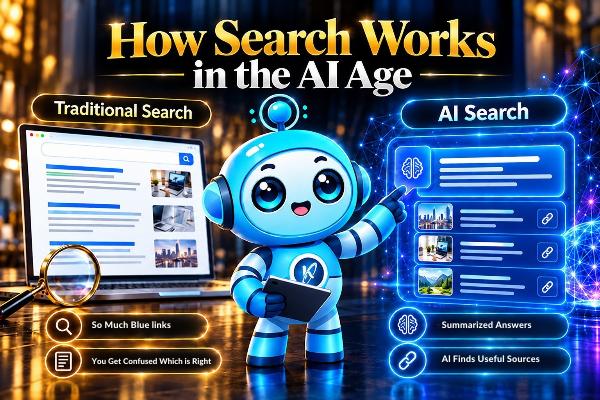
Remember the time when you typed a few words into Google and got a long list of blue links? You had to click through each one, read the page, and try to find the answer yourself. That world is changing fast. Today, when you search for something online, artificial intelligence steps in to understand your question, find the best answer, and even give it to you directly on the search page. This shift is not just a small update. It is one of the biggest changes in how we find information since the internet began.
Modern search engines like Google, Bing, and newer AI-powered tools such as ChatGPT Search, Perplexity AI, and Google’s AI Overviews are now reading your intent, not just your words. They can figure out what you really want to know, even if you do not ask it perfectly. This means that if you own a business, create content online, or just use the internet daily, you need to understand how this new kind of search works and how it affects you.
In this guide, we explain everything in simple language. Whether you are a student, a small business owner, or just a curious person, this blog will help you understand the new AI-powered search world and what you should do about it.
What Exactly Is AI-Powered Search?
From Keywords to Understanding
Traditional search engines worked by matching words. You typed ‘best pizza near me’ and the engine looked for pages that contained those exact words. Modern AI search does something smarter. It uses natural language processing (NLP) to understand the meaning behind your words, not just the words themselves.
For example, if you ask ‘why does my stomach hurt after eating oily food?’, the AI understands that you are looking for health reasons related to digestion, not just pages with all those words on them. It then gives you a direct, helpful answer.
The Technologies Behind AI Search
- Large Language Models (LLMs): These AI systems are trained on billions of web pages and can generate human-like answers.
- Natural Language Processing (NLP): Helps the machine understand the meaning of sentences, not just individual words.
- Semantic Search: Finds content based on meaning and context rather than exact keyword matches.
- Knowledge Graphs: Databases that connect facts, people, places, and concepts so AI can give more accurate answers.
- Machine Learning Rankings: Algorithms that learn from what users click on and reward helpful content.
How Google's AI Overview Changes the Search Experience
What Is Google AI Overview?
Here is how it works in simple steps:
- You type a question in Google Search.
- Google’s AI reads thousands of web pages in milliseconds.
- It creates a summarized answer using information from multiple trusted sources.
- That summary appears at the top of your screen.
- Below the summary, you still see regular search results.
What This Means for Website Owners
If Google gives the answer directly on the search page, fewer people may click through to your website. This is called a ‘zero-click search.’ For businesses and content creators, this is a real challenge. Your content might be used to generate the AI answer without the user ever visiting your site.
| Search Type | User Gets | Website Clicks |
| Old Search (Keywords) | List of links | High |
| AI Overview Search | Direct AI answer + links | Lower |
| Voice Search / AI Chat | Spoken/typed answer only | Very Low |
How AI Decides Which Content to Trust and Show
The EEAT Framework: Experience, Expertise, Authority, Trust
Google uses a quality framework called EEAT to judge whether content is good enough to show in AI answers. Here is what each letter means:
- Experience: Has the author actually done or lived what they are writing about?
- Expertise: Does the author have real knowledge or qualifications in the topic?
- Authoritativeness: Is the website known and respected in its field?
- Trustworthiness: Is the content accurate, honest, and reliable?
For example, a medical article written by a certified doctor on a well-known health website has high EEAT. A random blog post written by an unknown person without any sources has low EEAT. AI systems prefer high-EEAT content.
Structured Data Helps AI Understand Your Page
Structured data (also called Schema Markup) is like a label on your content that tells search engines exactly what type of information is on the page. If you add structured data for FAQs, reviews, events, or products, AI search engines can read and use your content more easily.
What Is Semantic SEO and Why Does It Matter Now?
Semantic SEO means creating content that covers a topic deeply and connects related ideas together. Instead of writing a blog post just about ‘SEO tips,’ a semantic SEO approach would cover the full topic of ‘how search engines rank content’ including subtopics like technical SEO, content quality, link building, and user experience.
Benefits of semantic SEO in the AI search era:
- Your content is more likely to be used in AI-generated answers.
- You rank for many related keywords, not just one.
- Users stay longer on your site because you answer all their related questions.
- Google sees your website as a trusted authority on the topic.
Practical Tips: How to Adapt Your Online Presence for AI Search
For Business Owners
- Write content that answers real questions your customers ask.
- Add FAQ sections to every important page on your website.
- Make sure your business information (name, address, phone) is consistent across all platforms.
- Collect genuine reviews from real customers on Google and other platforms.
- Claim and optimize your Google Business Profile.
For Content Creators and Bloggers
- Focus on depth, not just length. Cover every angle of your topic.
- Write in simple, clear language that even a Grade 7 student can understand.
- Use headings, bullet points, tables, and examples to make content easy to read.
- Cite sources and link to authoritative websites to build trust.
- Update old content regularly to keep it accurate and fresh.
For Everyday Users
- AI search is faster and more helpful, but always check sources for important decisions.
- Use specific, question-based searches to get better AI answers.
- Do not rely only on the AI summary for medical, legal, or financial decisions.
The Rise of Voice Search and Conversational AI
More and more people are now using voice assistants like Google Assistant, Siri, Alexa, and Cortana to search the internet. Voice search is almost always a question, like ‘What is the best time to visit Goa?’ or ‘How do I fix a leaking tap?’ This kind of search is very conversational.
AI-powered conversational search engines like ChatGPT, Gemini, and Perplexity are also growing fast. These tools can hold a full conversation with you, remember what you said before in the chat, and give detailed, step-by-step answers. For businesses, this means your content needs to be written in a natural, conversational tone to have any chance of appearing in these AI-powered answers.
Conclusion: Adapt Early and Win in AI-Driven Search
The shift from traditional keyword-based search to AI-powered understanding is not slowing down. It is speeding up. Every major search engine is investing billions into making AI smarter, faster, and more helpful. For users, this is great news because finding information is easier than ever. For businesses and content creators, it is a call to action.
The winners in this new world will be those who create genuine, helpful, and well-structured content. Not those who try to game the system with tricks. If you focus on truly helping your audience and build real expertise in your field, the AI systems will recognize and reward your work. Start adapting today and stay ahead of the curve.
Frequently Asked Questions (FAQs)
AI-powered search uses artificial intelligence to understand the meaning of your question and give you a direct, helpful answer instead of just showing a list of links.
Google AI Overview may reduce the number of people clicking through to your website because the answer is shown directly on the search page. This is called a zero-click search.
EEAT stands for Experience, Expertise, Authoritativeness, and Trustworthiness. Google uses these four factors to judge whether content is high quality and worth showing in search results.
Semantic SEO means creating content that deeply covers a topic and connects related ideas, so search engines see your website as a trusted authority on that subject.
Semantic SEO means creating content that deeply covers a topic and connects related ideas, so search engines see your website as a trusted authority on that subject.
Yes, structured data (Schema Markup) helps AI search engines understand your content better and increases the chance of your information being used in AI-generated answers.
A small business should focus on answering real customer questions on their website, get genuine reviews, keep business information consistent everywhere online, and optimize their Google Business Profile.
Yes, voice search is growing rapidly. Content written in natural, conversational language has a better chance of appearing in voice search results and AI chatbot answers.