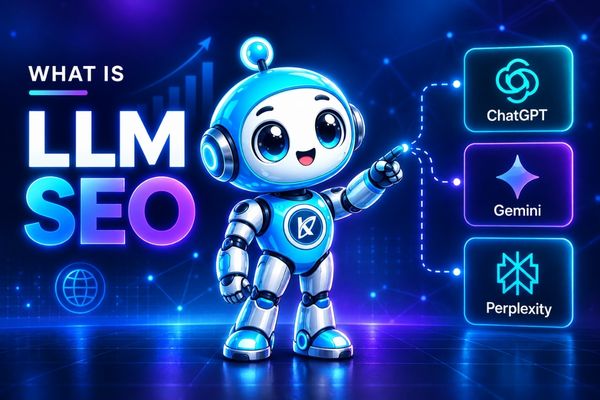
LLM SEO for Small Businesses: How to Get Cited by ChatGPT, Gemini and Perplexity
Search behaviour is changing quickly. Customers are no longer using only Google to find products, services and local businesses. They are also asking platforms such as ChatGPT, Gemini and Perplexity for direct recommendations.
A potential customer might ask:
“Which is the best industrial pump manufacturer in Gujarat?”
“Suggest a reliable website design company in Ahmedabad.”
“Which dental clinic offers microscopic root canal treatment near me?”
Instead of displaying ten traditional search results, an AI platform may provide one detailed answer containing only a few recommended businesses and cited sources.
This creates a new challenge for small businesses. Ranking on Google is still important, but businesses must also become visible inside AI-generated answers.This emerging practice is known as LLM SEO, AI Search Optimization, Generative Engine Optimization or GEO.
What Is LLM SEO?
LLM SEO is the process of improving your website and overall online presence so large language models can discover, understand, trust and reference your business.
LLM stands for Large Language Model. ChatGPT, Gemini and Perplexity use large language models to understand questions and generate conversational answers.
Traditional SEO focuses mainly on ranking webpages in search engine results. LLM SEO focuses on increasing the possibility of your company, content or website being mentioned and cited inside AI-generated answers.
For example, traditional SEO may help your website appear on the first page of Google for:
“SEO company in Ahmedabad”
LLM SEO may help your company appear when someone asks ChatGPT:
“Which SEO company in Ahmedabad provides GEO and AEO services for small businesses?”
The objective is not only to rank. The objective is to become a trusted source that AI platforms can confidently use in their responses.
LLM SEO vs Traditional SEO
Traditional SEO and LLM SEO are closely connected, but they do not have exactly the same objective.
| Factor | Traditional SEO | LLM SEO |
|---|---|---|
| Main Objective | Rank webpages in search results | Get mentioned or cited in AI answers |
| Main Platforms | Google and Bing | ChatGPT, Gemini, Perplexity and AI Overviews |
| User Behaviour | Short keyword searches | Detailed conversational questions |
| Primary Result | Website link and description | Generated answer with sources |
| Important Signals | Keywords, backlinks, technical SEO and user experience | Clear answers, expertise, citations, brand authority and online consistency |
| Performance Measurement | Rankings, impressions, clicks and traffic | AI mentions, citations, cited pages and referral traffic |
LLM SEO does not replace traditional SEO. It builds on it.
Google has officially confirmed that established SEO practices continue to support visibility in AI Overviews and AI Mode because these features use Google’s existing search and quality systems. Google’s AI search optimization guidance
A website that cannot be crawled, indexed or understood by search engines will also struggle to gain visibility in AI search.
What Are GEO, AEO and AI Search Optimization?
Generative Engine Optimization
Generative Engine Optimization or GEO focuses on increasing a brand’s visibility within answers generated by platforms such as ChatGPT, Gemini and Perplexity.
The term became widely known after researchers introduced a formal GEO framework for measuring and improving content visibility in generative engines. Their research demonstrated that optimization could improve visibility under controlled experimental conditions, although results varied significantly across subjects. Foundational GEO research
Answer Engine Optimization
Answer Engine Optimization or AEO focuses on structuring content so search engines and AI platforms can identify clear answers to user questions.
AEO is particularly useful for:
- Frequently asked questions
- Voice searches
- Featured snippets
- Google AI Overviews
- Conversational searches
- Product and service comparisons
LLM SEO
LLM SEO is a broader term that covers website optimization, content creation, technical accessibility, brand authority and AI visibility tracking.
In practical terms, small businesses do not need separate strategies for SEO, GEO, AEO and LLM SEO. They need one integrated search strategy that helps customers find them through both traditional search results and AI-generated answers.
How ChatGPT, Gemini and Perplexity Find Information
AI platforms do not always answer questions from memory. When users need current information, these systems may search the web, retrieve relevant webpages and use those pages to prepare an answer.
How ChatGPT Finds Sources
ChatGPT can search the web and provide links to relevant sources. OpenAI uses a crawler called OAI-SearchBot to discover content that may appear in ChatGPT search results.
OpenAI recommends allowing OAI-SearchBot to access public website content if a publisher wants that content to be discovered, summarized and cited. ChatGPT referral URLs can include utm_source=chatgpt.com, which helps website owners identify ChatGPT traffic in analytics reports. OpenAI’s publisher guidance
How Gemini Finds Sources
Gemini and Google’s AI search experiences are closely connected with Google Search.
Google may use retrieval-augmented generation and query fan-out. Query fan-out means that Google can break one complex question into several related searches, collect information from different sources and combine the findings into one response.
Therefore, strong Google indexing, helpful content and technical SEO remain essential for gaining visibility in Gemini-powered search experiences.
How Perplexity Finds Sources
Perplexity is designed as an answer engine that searches the web and displays citations with its responses.
Perplexity uses PerplexityBot to discover and link to websites in its search results. Website owners should ensure that robots.txt rules and security systems are not unintentionally blocking this crawler. Perplexity crawler documentation
How to Measure LLM SEO Performance
Traditional keyword rankings are not enough to measure AI search visibility.
Track the following metrics:
| Metric | What It Measures |
|---|---|
| AI Mention Rate | How frequently your business appears in tracked AI answers |
| Citation Rate | How frequently an AI platform links to your website |
| Cited URLs | Which pages are being selected as sources |
| AI Share of Voice | Your visibility compared with competitors |
| Brand Description | Whether AI presents your company accurately and positively |
| Referral Traffic | Visits received from AI platforms |
| Assisted Conversions | Enquiries influenced by AI search |
| Branded Searches | Growth in people searching for your company name |
ChatGPT referral traffic can be identified through the utm_source=chatgpt.com parameter. You can monitor this traffic in Google Analytics.
For Google’s AI search features, use the available generative AI performance information in Google Search Console where accessible.
Common LLM SEO Mistakes
Publishing Large Amounts of Generic AI Content
Using AI to assist with research or structure is acceptable, but publishing hundreds of low-value pages can create quality and spam problems.
Every article should include useful information, human review and genuine expertise.
Keyword Stuffing
Repeating “LLM SEO,” “GEO services” or “AI search optimization” unnecessarily will not make content more trustworthy.
Use keywords naturally and focus on answering the reader’s question.
Treating LLMS.txt as a Ranking Shortcut
An LLMS.txt file is sometimes promoted as essential for AI search visibility. Google officially states that it does not use LLMS.txt for Google Search or its generative AI features.
Creating the file may be useful for systems that choose to support it, but it should not replace crawlability, technical SEO and useful content.
Depending Only on Schema Markup
Structured data can improve understanding and eligibility for rich results, but it cannot compensate for weak or unhelpful content.
There is no special “AI schema” that guarantees a citation.
Buying Fake Brand Mentions
Artificial reviews, spammy directory submissions and paid mentions on unrelated websites can damage credibility.
Focus on authentic reviews, relevant partnerships and useful expert contributions.
Expecting Guaranteed Results
AI platforms are dynamic. They may change their sources based on the question, location, wording, freshness and available information.
No agency can honestly guarantee that a business will always be recommended by ChatGPT, Gemini or Perplexity.
A Simple 30-Day LLM SEO Plan for Small Businesses
Week 1: Technical Review
- Check Google indexing
- Review robots.txt
- Check AI crawler access
- Submit the XML sitemap
- Fix broken links
- Review mobile speed
- Verify analytics tracking
Week 2: Business Entity Optimization
- Improve the About Us page
- Add expert team profiles
- Update contact information
- Optimize Google Business Profile
- Correct inconsistent directory listings
- Add appropriate structured data
Week 3: Content Improvement
- Identify 20 real customer questions
- Improve five important service or product pages
- Add direct answers and FAQs
- Include original examples
- Add credible supporting sources
- Improve internal links
Week 4: Visibility Testing
- Create 25 relevant AI prompts
- Test them in ChatGPT, Gemini and Perplexity
- Record mentions and citations
- Compare results with competitors
- Identify missing content
- Prepare the next content cluster
Final LLM SEO Checklist
Before publishing or updating a page, ask:
- Is the page crawlable and indexable?
- Does it answer a specific customer question?
- Is the main answer easy to find?
- Does it include first-hand expertise?
- Is the author clearly identified?
- Improve internal links
- Is the business information consistent?
- Does the page link to related content?
- Are images original and relevant?
- Is the content current?
- Does the page provide something competitors do not?
- Would a real customer find the page useful?
Conclusion
LLM SEO gives small businesses an opportunity to become visible wherever customers search, including Google, ChatGPT, Gemini and Perplexity.
The strongest strategy is not based on tricks. It is based on making your website accessible, publishing genuinely useful information, demonstrating real expertise and building a trustworthy brand presence across the web.
Traditional SEO remains the foundation. GEO and AEO expand that foundation by helping your information become easier to understand, retrieve and cite inside AI-generated answers.
Businesses that start improving their AI search visibility today can build authority before their competitors fully understand this new search environment.
Related Posts
Best AI SEO Tools for GEO, AEO and AI Visibility in 2026
Best AI SEO Tools in 2026 for GEO, AEO and AI Visibility You Can Measure…
AI SEO Audit Checklist: Make Your Website Easier for ChatGPT and Google AI Overviews to Cite
AI SEO Audit Checklist for ChatGPT and Google AI Overviews A top Google ranking no…
AI Search Optimization in 2026: Rank in ChatGPT, Gemini and Perplexity
The Complete Guide to AI Search Optimization in 2026: How to Rank in ChatGPT, Gemini…