The New Gatekeepers of Online Traffic
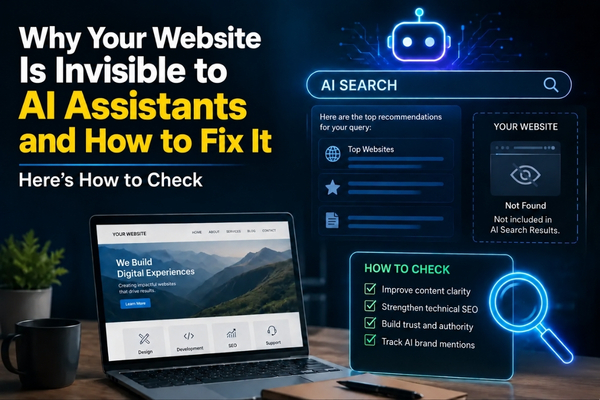
If you built your website a few years ago and focused on traditional SEO, you might have done everything right. Good keywords, quality content, proper backlinks. And yet today, when someone asks an AI assistant like ChatGPT, Google Gemini, or Perplexity about your topic, your website does not come up. It is as if you do not exist. This problem is real and it is growing every single day as more people switch from traditional search to AI-powered tools.
The frustrating part is that AI assistants are not skipping your website on purpose. They simply cannot understand or trust your content the way they can understand content that is structured for AI readability. Think of it like trying to read a book with no chapters, no headings, and no table of contents. The information might be there, but finding and using it is very difficult.
In this blog, we explain in simple terms why this happens and give you a clear, practical plan to make your website visible to AI tools, voice assistants, and the next generation of search engines. The good news is that fixing this does not require any technical degree. You just need the right knowledge.
What Is Answer Engine Optimization (AEO)?
AEO: The Next Step After SEO
Traditional SEO (Search Engine Optimization) helped your website rank on Google’s blue link pages. AEO, or Answer Engine Optimization, helps your website get featured in AI-generated answers, voice search results, and featured snippets. The goal of AEO is to make your content so clear and well-organized that AI systems can extract your answer directly and use it when someone asks a related question.
| Feature | Traditional SEO | Answer Engine Optimization (AEO) |
| Goal | Rank on search pages | Be featured in AI answers |
| Format | Long paragraphs and keywords | Clear Q&A, structured data, snippets |
| Target | Search engine crawlers | AI systems and voice assistants |
| Output | Website clicks | Direct answers with source credit |
| Measurement | Keyword rankings | Featured snippets, AI citations |
For Business Owners
Here are the most common reasons why AI tools ignore websites:
- No clear question-and-answer structure on the page.
- Content is written for search bots, not for real people's questions.
- No schema markup or structured data to label the content type.
- Thin content that does not go deep enough on a topic.
- Slow website loading speed makes it hard to crawl and index.
- No FAQs, no comparison tables, no step-by-step guides.
- Low EEAT signals (no author bio, no citations, no trust signals).
How AI Tools Decide What Content to Use
The Content Quality Checklist AI Systems Use
AI systems are trained to prefer content that is accurate, clear, well-organized, and comes from trusted sources. When an AI scans your page, it looks for several things:
- Direct answers to specific questions (preferably in the first 2-3 sentences of a section).
- Factual information supported by data, examples, or expert opinion.
- A logical structure with proper headings (H1, H2, H3, H4).
- Content that matches the real intent behind the question.
- Schema markup that labels your content correctly.
- Author information that shows real expertise.
- Links to or from authoritative sources.
The Role of Featured Snippets in Getting AI Attention
Featured snippets are the short answer boxes that appear at the top of Google’s search results. If your content is structured to win a featured snippet, it is also very likely to be used by Google’s AI Overview and other AI tools. The key is to answer a specific question in 40-60 words, right at the start of a clearly labeled section.
5 Practical Steps to Make Your Website AI-Friendly
Step 1: Add a FAQ Section to Every Important Page
FAQs are the single most powerful tool for AEO. Every page on your website that answers a question should have an FAQ section at the bottom. Write the questions exactly how your customers would ask them in real life. Then give clear, concise answers. This structure is exactly what AI assistants are looking for.
Step 2: Use the Inverted Pyramid Writing Style
Put the most important answer first, then explain the details. Journalists call this the inverted pyramid. When AI scans your page, it often only reads the first few sentences of each section. If your answer is buried at the bottom of a long paragraph, the AI will miss it.
Example of the wrong way:
❌ ‘Many businesses have struggled for years with understanding the complex topic of digital marketing, and after consulting with experts and studying numerous case studies across different industries, we have come to the conclusion that the best approach is to start with SEO.’
Example of the right way:
✅ ‘The best starting point for digital marketing is SEO. It drives free traffic, builds long-term visibility, and works for businesses of all sizes. Here is a step-by-step guide to getting started.’
Step 3: Add Schema Markup (Structured Data)
Schema markup is code you add to your website's backend that tells search engines and AI tools exactly what type of content is on your page. For most businesses, the most important schema types are:
• FAQ Schema: Labels your FAQ questions and answers.
• Article Schema: Labels your blog posts with title, author, and date.
• LocalBusiness Schema: Tells AI your business name, address, phone, and hours.
• Review Schema: Shows your star ratings and customer reviews to AI.
• HowTo Schema: Labels step-by-step guides.
Step 4: Write Like You Are Talking to a Smart 12-Year-Old
Use simple words. Short sentences. No unnecessary jargon. If your content is easy for a school student to understand, it is also easy for AI to process and summarize. Long, complex sentences confuse both readers and AI systems.
Step 5: Build Topical Authority with Clusters of Content
Instead of writing one blog post about 'digital marketing,' write 10-15 articles that each cover a specific part of the topic in depth. Then link them all together. This creates a topical cluster that signals to AI systems that your website is a deep, reliable source on this subject. When AI is deciding who to trust, it picks the site that covers the topic most completely.
Common Mistakes That Keep Websites Invisible to AI
| Mistake | Why It Hurts AI Visibility | How to Fix It |
| Keyword stuffing | AI ignores unnatural, forced content | Write naturally for humans first |
| No author bio | Low trust and E-E-A-T signals | Add author name, photo and credentials |
| No internal links | AI cannot easily map your site's topic depth | Link related articles together |
| Outdated content | AI systems may prefer fresh and accurate information | Review and update posts every 6–12 months |
| Pop-ups blocking content | Important content may become harder for crawlers to access | Remove unnecessary pop-ups or delay them |
| Missing H1/H2/H3 tags | Page structure becomes harder to understand | Use a clear and logical heading hierarchy |
Conclusion: Being Found in the AI Era Requires a New Mindset
The rules of being found online have changed. It is no longer enough to have a website with keywords. In the age of AI assistants and zero-click searches, your content needs to be structured, trustworthy, and genuinely helpful. If you follow the steps in this guide, your website will become much more visible to AI tools, featured snippet results, and the new generation of users who ask questions instead of typing keywords.
Start with the small fixes first: add FAQs to every page, fix your headings, and add your author bio. These simple changes can make a surprisingly large difference in how AI systems perceive and use your content. The business that adapts fastest will win the most customers in the AI-first world ahead.
Frequently Asked Questions (FAQs)
AEO is the process of optimizing your website content so that AI tools, voice assistants, and search engines can extract and use your answers when someone asks a related question online.
Common reasons include lack of structured data, no FAQ sections, content not written in a question-answer format, low EEAT signals, and poor page structure with missing headings.
Schema markup is special code that labels your content for search engines and AI. Yes, it is very important. FAQ schema, Article schema, and LocalBusiness schema are the most valuable types.
After making changes, you may start to see improvements in 4 to 12 weeks, depending on how often search engines re-crawl your pages and update their AI training data.
Yes. AI tools often prefer highly specific, trustworthy answers over generic content from large websites. A small business that covers its niche topic deeply and accurately can outrank larger competitors.
Topical authority means your website is recognized as an expert source on a specific subject. Build it by publishing a cluster of detailed, interlinked articles all focused on that subject area.
They are related but not identical. Voice search uses AI to process spoken queries, while AI search also includes text-based AI assistants like ChatGPT and Gemini that generate full answers.
Related Posts
How Search Works in the AI Age and What It Means for You
Search Has Changed Forever Remember the time when you typed a few words into Google…