 Introduction
Every business wants growth — but the real question is how to achieve it effectively. Today’s digital world offers two main routes:
- Paid Ads (PPC, Social Ads, Display Ads, etc.)
- Organic Growth (SEO, Content Marketing, Social Media Engagement, etc.)
Both strategies are powerful, but they serve different purposes. Paid ads bring instant results, while organic growth builds long-term credibility. The key is knowing when to use each, and how to combine them for maximum impact.
In this blog, we’ll dive deep into paid ads vs. organic growth, explore their advantages and limitations, and help you decide the best approach for your business in 2025.
What is Paid Advertising?
Paid advertising refers to sponsored campaigns where you pay platforms like Google, Facebook, Instagram, or LinkedIn to showcase your business.
Popular Platforms:
- Google Ads – Search & Display Network
- Meta Ads – Facebook & Instagram
- YouTube Ads – Video campaigns
- LinkedIn Ads – Ideal for B2B lead generation
- E-commerce Ads – Amazon, Flipkart, Myntra
Types of Paid Ads:
- Search Ads (PPC) – Appear on Google search results.
- Display Ads – Visual banners across websites.
- Video Ads – YouTube, Reels, Shorts.
- Shopping Ads – For e-commerce product listings.
- Social Media Ads – Boosted posts, lead gen forms, carousel ads.
How Payment Models Work:
- CPC (Cost per Click): Pay when someone clicks.
- CPM (Cost per Mille): Pay per 1000 impressions.
- CPA (Cost per Acquisition): Pay for actual conversions.
Paid ads = instant traffic, but costs money directly.
What is Organic Growth?
Organic growth means building your audience naturally without paying for direct visibility. It relies on SEO, content marketing, and social engagement.
Channels for Organic Growth:
- Search Engine Optimization (SEO) – Blogs, backlinks, keywords.
- Content Marketing – Blogs, case studies, infographics, videos.
- Social Media Growth – Posting valuable, share-worthy content.
- Email Marketing – Newsletters, drip campaigns.
- YouTube/Video Content – Organic subscribers and engagement.
Organic = free traffic, but takes time and consistent effort.
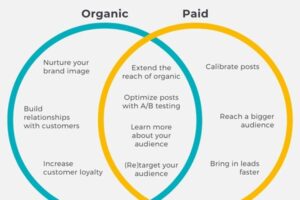
Key Differences Between Paid Ads & Organic Growth
Factor | Paid Ads (PPC) | Organic Growth |
Speed of Results | Instant (within hours/days) | Slow (3–12 months) |
Cost | High ongoing spend | Low upfront cost, time-intensive |
Trust Factor | Users know it’s an ad | More credible, natural trust |
Scalability | Easy to scale with budget | Scales slowly with consistency |
Sustainability | Stops when you stop paying | Keeps growing with time |
Targeting | Highly specific (age, location, interests) | Broader, based on SEO reach |
ROI Timeline | Short-term | Long-term |
Best Use Case | Product launches, seasonal sales | Authority building, evergreen growth |
Advantages of Paid Ads
- Instant Visibility – Appear at the top of Google or social feeds.
- Laser Targeting – Choose your exact audience.
- Perfect for Launches/Offers – Great when you need results NOW.
- Measurable ROI – Detailed analytics and conversion tracking.
- Scalable – More budget = more reach.
Limitations of Paid Ads
- Costly in highly competitive industries.
- ROI vanishes when you stop paying.
- Ad fatigue (people skip/ignore ads).
- Requires expertise to optimize properly.
- Can burn budget quickly if mismanaged.
Advantages of Organic Growth
- Long-Term Results – Once ranked, blogs/videos keep bringing traffic.
- Builds Authority – Trust from users, Google, and social platforms.
- Cost-Effective – Requires time and skill, not constant payments.
- Higher Engagement – People trust organic posts more than ads.
- Compounding Effect – Old content keeps paying dividends.
Limitations of Organic Growth
- Takes months before you see real impact.
- Requires ongoing effort and consistency.
- Algorithm changes (Google updates, Instagram reach drops).
- Harder to scale quickly compared to ads.
When to Use Paid Ads
- Launching a new product/service (need visibility fast).
- Seasonal promotions (Diwali, Christmas, Black Friday).
- Competitive industries (e.g., real estate, finance, education).
- Events/Webinars where timing is critical.
- Testing ideas/markets before investing in long-term SEO.
When to Use Organic Growth
- Building brand credibility in your industry.
- Limited marketing budgets but long-term vision.
- Evergreen industries (education, healthcare, SaaS).
- Authority building (blogs, podcasts, thought leadership).
- Sustainable lead flow (so you don’t depend only on ads).
The Best Strategy → Combine Both
Truth is: Paid ads + Organic growth = Maximum ROI.
- Use ads to generate traffic fast.
- Use SEO & content to build a long-term foundation.
- Together, they balance each other.
Example:
- E-commerce store: Launch a product with Google Shopping Ads → use SEO blogs + product guides for long-term ranking.
- Education institute: Run Facebook Ads for admissions → build authority with blogs like “Best Design Courses in Ahmedabad.”
Case Studies
Case Study 1: Startup with Paid Ads
A SaaS startup spent ₹1.5 lakh on Google Ads for 3 months. Result? 400+ trial sign-ups in record time. Paid ads gave them speed.
Case Study 2: Manufacturing Company with Organic SEO
A pump manufacturer invested in SEO blogs + backlinks. Within 9 months, they ranked top 3 for “Industrial Pumps in Gujarat” and got consistent inbound leads without paying per click.
Case Study 3: Hybrid Approach
An e-commerce brand combined both: used ads for product launches + SEO blogs for evergreen keywords. Today, 50% of sales come from SEO, 50% from ads.