
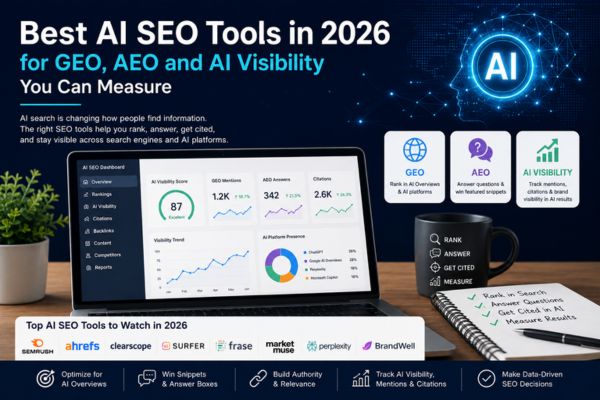
Best AI SEO Tools in 2026 for GEO, AEO and AI Visibility You Can Measure
A page can rank well in Google and still disappear from an AI answer. People now find brands through summaries, product recommendations, cited sources, and conversational search results. The best AI SEO tools in 2026 help teams track three outcomes: organic rankings, answer engine visibility, and inclusion in generative AI responses.
Why AI search changed SEO measurement
Three visibility outcomes matter
Traditional SEO measures clicks, impressions, rankings, links, and technical health. AEO focuses on being selected for direct answers, featured snippets, voice results, and question-based searches. GEO tracks brand mentions, citations, sentiment, and recommendations inside systems such as Google AI features, Microsoft Copilot, ChatGPT, Perplexity, and Gemini.
These signals overlap, but they aren’t interchangeable. A brand may appear in an AI response without receiving a click. Google says AI Overviews and AI Mode traffic is included in the Search Console Performance report under the “Web” search type, while third-party AI interactions may remain difficult to attribute.
What makes an AI SEO tool useful
Judge each platform by query coverage, data accuracy, citation evidence, technical SEO functions, content support, integrations, scale, and total cost. Separate tools that generate content from tools that show whether search systems can understand, retrieve, cite, or recommend that content.
Generative answers can change with model versions, location, language, browsing status, personalization, and prompt wording. Any reliable platform should record these conditions and support repeat testing.
Choosing the Best AI SEO Tools in 2026 for GEO, AEO and AI Visibility
Traditional SEO tools remain the base
Semrush, Ahrefs, Moz Pro, SE Ranking, Google Search Console, Bing Webmaster Tools, Screaming Frog, and Sitebulb cover rankings, crawlability, backlinks, keyword demand, competitors, indexation, and organic traffic. These functions still matter because AI systems need accessible pages, clear entities, useful internal links, reliable facts, and crawlable site structures.
Google’s guidance says pages must be indexed and eligible for normal search snippets to qualify as supporting links in AI Overviews and AI Mode. It also recommends crawl access, internal linking, visible text, matching structured data, and current Business Profile or Merchant Center information.
GEO tools track mentions and citations
Profound, Peec AI, Otterly.AI, and similar platforms focus on generative engine optimization. They can track prompts, brand mentions, cited URLs, competitors, sentiment, share of voice, and answer changes across selected AI systems.
Check whether a product stores the full response, source links, model, date, country, language, and prompt. A single screenshot proves little. Repeated tests across a fixed prompt set produce more useful trend data.
AEO tools improve answer-ready pages
AlsoAsked and AnswerThePublic help discover related questions and customer language. Frase, Surfer, Clearscope, and MarketMuse support briefs, topic coverage, readability, and SERP analysis. InLinks, WordLift, Schema App, and schema testing tools help clarify entities, relationships, and page meaning.
Question research shows what people ask. It doesn’t prove that a search engine cites your page. Content scores also guide editing; they don’t guarantee rankings, recommendations, or AI inclusion.
Compare AI SEO tools by core capability
The following framework keeps tools with different jobs from being judged by the same score.
| Tool or Group | Pricing | Primary Use | Ideal Customer | Integrations and Coverage | Key Limitation |
|---|---|---|---|---|---|
| Google Search Console | Free | Organic and AI-feature performance | Every site | Google Search, API, Analytics workflows | No broad third-party prompt tracking |
| Semrush, Ahrefs, Moz Pro, SE Ranking | Paid tiers; verify current plans | SEO research, audits, links, rankings | Agencies and in-house teams | GSC, analytics, APIs vary; search databases | GEO and model coverage differs by product |
| Profound, Peec AI, Otterly.AI | Paid or custom pricing; verify | GEO monitoring | Brands and agencies | AI prompt and citation coverage varies | Sampling may not match every user |
| Frase, Surfer, Clearscope, MarketMuse | Paid tiers; verify | Briefs and content optimization | Publishers and content teams | Editors, documents, SERP data vary | Scores aren't ranking guarantees |
| Screaming Frog and Sitebulb | Free limits or paid licenses; verify | Crawling and technical audits | SEO teams and developers | Rendering, analytics, Search Console options vary | Doesn't measure AI answers |
| AlsoAsked, AnswerThePublic | Free limits or paid tiers; verify | Question research | Small teams and writers | Question databases and exports vary | Finds questions, not citations |
| InLinks, WordLift, Schema App | Paid or custom pricing; verify | Entities, internal links, schema | Enterprise and publishers | CMS, APIs, structured data workflows | Markup cannot guarantee inclusion |
Features, tracked prompts, seats, API access, and prices change often. Confirm current vendor terms before purchase.
Match tools to a measurable SEO workflow
Build a visibility baseline first
Export clicks, impressions, queries, pages, and countries from Search Console. Add rankings for branded, commercial, comparison, local, and informational queries, then record competitor results.
Create a fixed AI prompt set covering brand, category, product, problem, comparison, and local intent. Record mentions, citations, sentiment, factual errors, recommendation position, and competing brands.
Turn demand into answer-ready content
Group keywords by intent instead of creating one page for every wording variation. Combine keyword data with support tickets, sales calls, customer reviews, question tools, and competitor gaps.
Prioritize topics where the business has real expertise, original evidence, product relevance, or a clear customer benefit. Use content software to find missing entities, subtopics, questions, and internal links, but keep expert review in the workflow.
Improve retrieval and citation
Put direct answers near the start of relevant sections. Use clear headings, short definitions, comparison tables, lists, dates, bylines, evidence, and source links where they help readers verify claims.
Connect core pages with supporting guides, research, product pages, and service pages. Validate schema and make sure it matches visible content. Medical, legal, financial, and safety pages need fact-checking and qualified review.
Measure AI visibility without confusing it with rankings
Track observable and directional signals
| Metric | What It Shows | What It Cannot Prove |
|---|---|---|
| Mention Rate | How often the brand appears | That users saw or trusted it |
| Citation Rate | How often its domain or page is linked | That the citation caused a visit |
| Answer Share | Presence against chosen competitors | Total visibility across all prompts |
| Recommendation Position | Leading, secondary, or absent placement | Purchase intent |
| Sentiment and Accuracy | Whether descriptions are favorable and correct | Revenue impact |
| Citation Quality | Relevance, freshness, and authority of sources | Guaranteed future inclusion |
Track branded and nonbranded prompts separately. Keep location, language, date, device, and model conditions stable. Record major model, interface, algorithm, and content changes.
Connect visibility with business results
Compare AI trends with branded impressions, referral sessions, direct traffic, assisted conversions, leads, demos, and sales. Add campaign tags, CRM records, referral analysis, and post-conversion surveys when possible.
Attribution remains incomplete when a user reads an AI answer, later searches the brand, and converts through another channel. Report correlations unless a controlled test supports a causal claim.
Apply an AI SEO stack by business type
Small businesses need a lean stack
Start with Search Console, Bing Webmaster Tools, Analytics, a crawler, a schema validator, and a question research tool. Add GEO monitoring after defining priority prompts and business outcomes.
Local businesses should maintain accurate listings, service pages, reviews, contact details, business hours, credentials, and consistent names and addresses.
Agencies and enterprises need control
Agencies should compare Semrush, Ahrefs, SE Ranking, and GEO platforms for project separation, white-label reports, APIs, scheduled checks, exports, location controls, and client-level history.
Enterprise teams need permissions, security, data retention, regional reporting, multiple domains, language support, workflow approvals, and integrations with analytics, CRM, CMS, and digital experience platforms. Publishers should also track authorship, source attribution, dates, original reporting, and citation quality. Ecommerce teams need accurate product facts, feeds, reviews, pricing, availability, and Product or Organization schema.
Choose AI SEO tools with an evidence-first checklist
Confirm coverage, cost, and proof
Ask whether the platform measures the outcome you need: rankings, organic traffic, direct answers, mentions, citations, recommendations, sentiment, technical health, or content quality.
Verify model coverage, prompt controls, update frequency, geographic accuracy, historical access, API limits, sampling methods, and citation records. Calculate seats, tracked keywords or prompts, onboarding, training, integrations, and staff time alongside the subscription price.
Prefer tools that expose the exact response and support clear next actions. Avoid publishing unverified AI content or treating an opaque score as a business result.
Sources and research
Google’s AI features guidance explains eligibility, crawling, structured data, and Search Console reporting. Its people-first content guidance stresses original value, clear authorship, evidence, and expert review. Microsoft’s Bing Webmaster materials describe AI Performance reporting for citations in Copilot and Bing answers. The GEO research paper, accepted at KDD 2024, reported results from a benchmark, not a universal promise for every site.
Conclusion: Build an AI SEO stack tied to evidence
The best AI SEO tools in 2026 combine technical SEO, question research, content review, GEO monitoring, and first-party measurement. Choose products based on outcome fit, data transparency, prompt and model coverage, integrations, scale, and total cost.
No platform can guarantee a citation or recommendation. Establish a baseline, monitor priority prompts, improve pages that deserve to be cited, and connect visibility changes to leads, sales, and customer value. Recheck features, pricing, AI interfaces, and reporting methods before publishing your final buying decision.
Related Posts
LLM SEO for Small Businesses: How to Get Cited by ChatGPT, Gemini and Perplexity
LLM SEO for Small Businesses: How to Get Cited by ChatGPT, Gemini and Perplexity Search…
SEO vs GEO vs AEO vs AIO: Choose the Right Search Strategy for Your Business
SEO vs GEO vs AEO vs AIO: Choose the Right Search Strategy for Your Business…
AI Search Optimization in 2026: Rank in ChatGPT, Gemini and Perplexity
The Complete Guide to AI Search Optimization in 2026: How to Rank in ChatGPT, Gemini…