SEO vs GEO vs AEO vs AIO: Choose the Right Search Strategy for Your Business
Search visibility is no longer limited to ranking blue links. A business may appear in a traditional result, an AI-generated answer, a featured snippet, a voice response, or a recommendation from a generative platform.
SEO, GEO, AEO, and AIO target overlapping but different opportunities. Treating them as the same can create weak content, unclear reporting, and missed exposure across Google Search, AI Overviews, ChatGPT, Perplexity, Microsoft Copilot, and other discovery tools.
The right mix depends on your customers, sales cycle, industry, and goals. The key is knowing what each strategy does, where they overlap, and which visibility surface can influence revenue.
Search visibility now extends beyond traditional rankings
Search results now include links, answers, and recommendations
A typical search once meant scanning organic listings and choosing a page to visit. Users now also see featured snippets, People Also Ask results, maps, shopping listings, forums, voice responses, and AI summaries.
These formats can answer a question before a visitor reaches your website. Traditional rankings still matter, but they are one part of a wider search process.
The four acronyms describe different priorities
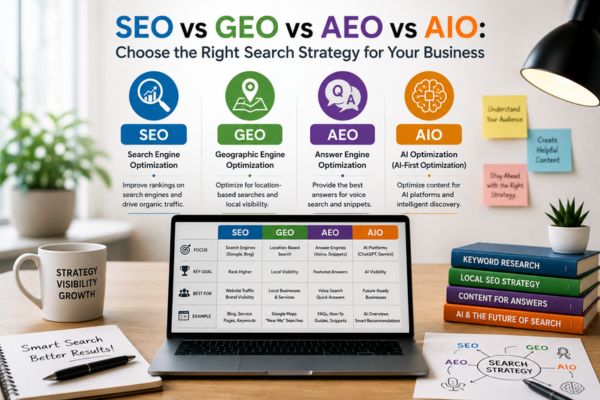
SEO focuses on visibility in search engines. AEO helps systems provide direct answers, while GEO aims to increase brand mentions and citations in generative responses.
AIO is broader. It prepares a company’s content, data, entities, and systems for use by AI tools. Definitions vary, and some marketers use AIO and GEO as synonyms.
Visibility does not always mean a website visit
SEO may produce a click, while AEO may produce a featured answer with no click. GEO can create a brand mention or citation, and AIO can support an AI-mediated action such as finding a product or service.
Each result needs its own success measure. Traffic alone cannot show the full value of search visibility.
SEO builds the foundation for qualified traffic
SEO helps search engines understand and rank content
Search engine optimization improves crawlability, indexation, site structure, internal links, page experience, mobile use, relevance, and authority. Helpful content, clear pages, strong internal links, valid structured data, and trusted references all support discovery.
No single ranking factor guarantees success. Search engines assess how well a page meets an intent and serves the user.
Search intent connects rankings to business value
Informational searches need guides and explanations. Commercial searches often need comparisons, reviews, and case studies, while transactional searches call for clear product or service pages.
A ranking has limited value when the page does not match the visitor’s goal. Map topics to intent before choosing content formats.
SEO priorities for most businesses
Start by fixing indexation barriers and building authoritative product or service pages. Improve titles, descriptions, internal links, first-hand expertise, and conversion paths.
Track rankings and impressions alongside qualified visits, leads, sales, and conversion rate. Strong SEO also gives AEO, GEO, and AIO better source material.
AEO earns visibility when users want direct answers
AEO targets questions and answer formats
Answer Engine Optimization structures content so systems can extract clear responses. Question research, descriptive headings, short definitions, ordered steps, comparison tables, lists, and useful FAQs can all help.
An FAQ section alone is not AEO. The answer must be accurate, visible, easy to understand, and supported by useful context.
Featured snippets and voice search show AEO in practice
Google featured snippets, People Also Ask results, knowledge panels, and voice assistants can expose a brand without a standard website visit. A page may win an answer for a narrow question while ranking lower for a broad topic.
Schema markup can clarify content through types such as FAQ, HowTo, Product, Organization, LocalBusiness, and Article. It must match visible page content and does not guarantee a rich result.
AEO priorities for answer-ready content
Place a direct answer near the top of relevant pages, then explain the details below it. Define technical terms plainly, answer related questions, cite reliable sources, and measure answer visibility, featured-result presence, and assisted conversions.
GEO increases inclusion in generative responses
GEO depends on clear facts and trusted sources
Generative Engine Optimization improves a brand’s chance of being cited, summarized, or recommended in Google AI Overviews, ChatGPT, Perplexity, Microsoft Copilot, and similar tools. These systems may combine information from several sources instead of selecting one ranking page.
Clear entities, expert authorship, original research, reputable citations, reviews, and useful comparison content can strengthen a brand’s source profile.
Generative engines assess the wider web
Your website is only one source of brand information. Professional groups, news sites, review platforms, directories, social profiles, and industry publications may also shape how AI tools describe your company.
Keep business facts consistent across these sources. No platform uses one public formula for every response, so avoid promises of guaranteed inclusion.
GEO requires flexible measurement
AI responses can change by prompt, location, user history, model, date, and platform. Track brand mentions, citations, linked sources, sentiment, factual accuracy, referral visits, branded searches, and visibility across a fixed set of relevant prompts.
AIO prepares information for AI systems
AIO covers the full information network
AI Optimization is an emerging term with no single accepted definition. Here, it means making website content, product feeds, business profiles, documentation, APIs, reviews, knowledge bases, and public facts easy for AI systems to find and interpret.
This broader focus differs from GEO, which centers more directly on inclusion in generative answers.
AIO also describes AI-assisted operations
Some teams use AIO to mean AI-assisted optimization. AI can help with research, content briefs, internal links, audits, personalization, and workflow automation.
That process does not prove a brand will appear in AI answers. Human review remains essential for accuracy, originality, privacy, and brand trust.
AIO priorities for growing organizations
Create one reliable source for business facts, standardize product and location data, validate structured data, and document content rules. Review automated output before publication and protect expert knowledge from low-quality mass production.
SEO vs GEO vs AEO vs AIO: the practical difference
| Strategy | Primary Goal | Typical Surfaces | Main Focus | Common Outcome |
|---|---|---|---|---|
| SEO | Earn rankings and clicks | Organic, image, local, shopping results | Crawlability, relevance, authority, intent | Traffic, leads, sales |
| AEO | Provide direct answers | Snippets, PAA, voice, answer features | Questions, concise answers, structure | Answer visibility, assisted actions |
| GEO | Gain AI mentions and citations | AI Overviews, ChatGPT, Perplexity, Copilot | Entity authority, clarity, corroboration | Citations, referrals, recommendations |
| AIO | Make information usable by AI | AI search, agents, assistants, connected tools | Data quality, structure, governance | Accurate discovery and AI actions |
One strong asset can support all four goals. A researched product comparison can rank in search, answer specific questions, supply facts for an AI summary, and add to the brand’s wider information footprint.
A local service company may prioritize SEO and AEO. An ecommerce brand may add GEO for product comparisons, while a large enterprise may need AIO to manage locations, feeds, documentation, and changing data.
Choose the right mix for your business
Match priorities to customer behavior
Prioritize SEO when you need durable organic demand, have weak technical foundations, or lack strong service and product pages. Choose AEO when customers ask repeated questions about complex products, support issues, or local services.
GEO deserves more attention when AI recommendations, vendor shortlists, and comparisons affect sales. AIO becomes critical when information is spread across many systems or changes often.
Build a staged roadmap
Begin with SEO fundamentals, then identify valuable customer questions for AEO. Strengthen authority, reviews, citations, and factual consistency for GEO, then scale structured data and governance through AIO.
The order can change. A software company with heavy AI research may test GEO early, while a retailer with poor product data should fix its core information first.
Measure clicks, answers, citations, and revenue
Use channel-specific metrics
SEO reporting should include impressions, rankings, organic sessions, crawl health, qualified traffic, leads, revenue, and conversion rate. AEO reporting can include featured-result visibility, People Also Ask presence, voice coverage, answer impressions, and assisted actions.
GEO metrics include mentions, citations, linked sources, sentiment, accuracy, referrals, and branded-search growth. AIO metrics include data completeness, entity consistency, schema validity, feed accuracy, documentation discovery, and successful AI-mediated actions.
Test real customer questions
Create a monitored query set based on product categories, locations, pain points, comparisons, and support needs. Test those prompts across relevant platforms, recording the date, location, device, model, response, sources, competitors, and factual errors.
Connect results to analytics, CRM records, call tracking, lead reviews, and customer surveys. AI answers may influence a sale without creating a directly attributable session.
Build one integrated content system
Organize content around problems and decisions
Create topic groups around customer problems, important entities, product attributes, comparison points, and post-purchase needs. Give each asset a primary intent and note which search surfaces it can support.
Use expert interviews, original research, case studies, documentation, glossaries, calculators, FAQs, templates, and decision guides. Clear evidence and authorship matter more than publishing volume.
Keep facts accurate across every source
Check names, locations, contact details, services, prices, product specifications, policies, credentials, and brand descriptions. Inconsistent facts can weaken trust and lead AI systems to produce inaccurate summaries.
Run regular technical audits, content refreshes, citation checks, prompt tests, review checks, and structured-data validations. Correct errors quickly.
Conclusion: Build visibility before, during, and after the click
SEO earns traditional search visibility. AEO helps systems deliver direct answers, GEO improves inclusion in generative responses, and AIO prepares the wider business information network for AI discovery and interpretation.
Most companies do not need four separate departments. They need strong SEO foundations, answer-ready content, credible authority signals, accurate structured information, and reporting tied to commercial results.
Start with the customer’s real search behavior. Then invest in the strategy that matches the surface most likely to influence your next lead, sale, booking, or recommendation.
Related Posts
Best AI SEO Tools in 2026 for GEO, AEO and AI Visibility You Can Measure
Best AI SEO Tools in 2026 for GEO, AEO and AI Visibility You Can Measure…
AI Search Optimization in 2026: Rank in ChatGPT, Gemini and Perplexity
The Complete Guide to AI Search Optimization in 2026: How to Rank in ChatGPT, Gemini…