
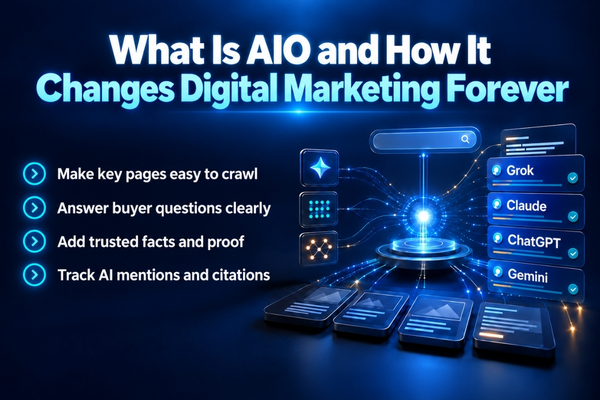
A New Layer on Top of SEO
The world of digital marketing is moving faster than ever. First came SEO (Search Engine Optimization), which helped businesses rank on Google. Then came social media marketing, content marketing, and paid ads. Now, a new discipline is emerging that is set to change everything again. It is called AIO, which stands for Artificial Intelligence Optimization. And if you are a business owner, marketer, or content creator, understanding AIO is not optional anymore. It is essential.
AIO is not just another buzzword. It is a real, practical approach to making your brand, your content, and your products work better with the AI systems that are now controlling how people find information, make decisions, and buy things online. From Google’s AI-powered search results to AI shopping assistants, from ChatGPT recommendations to AI-written product comparisons, artificial intelligence is now the middleman between your business and your customer.
In this blog, we break down what AIO really means, how it is different from traditional SEO, and most importantly, what you should start doing right now to make your business AI-ready. We keep everything simple, practical, and jargon-free so that anyone can understand and act on this information.
What Does AIO (Artificial Intelligence Optimization) Actually Mean?
The Simple Definition
AIO means optimizing everything about your brand’s online presence so that AI systems can find it, understand it, trust it, and recommend it. Just as SEO made your website rank higher on Google’s link pages, AIO makes your brand more likely to be mentioned, cited, or recommended by AI assistants, AI search tools, and AI shopping guides.
The Three Layers of AIO
- Content AIO: Making your written content easy for AI to read, trust, and use in AI-generated answers.
- Technical AIO: Ensuring your website’s structure, speed, and code are compatible with AI crawlers and language models.
- Brand AIO: Building your brand’s digital reputation so AI systems recognise your business as a trusted authority.
How AIO Is Different from Traditional SEO
| Aspect | Traditional SEO | AIO (AI Optimization) |
| Primary Goal | Rank high in link results | Get cited or used in AI answers |
| Audience | Search engine algorithms | AI language models + users |
| Key Technique | Keywords + backlinks | Structured content + E-E-A-T + entity optimization |
| Content Style | Keyword-rich paragraphs | Clear Q&A, schema, topic clusters |
| Metrics | Page rank, click-through rate | AI citations, zero-click impressions, brand mentions |
| Lifespan | Can be gamed short-term | Rewards genuine helpfulness long-term |
The biggest difference is the end goal. SEO gets you to the top of a list. AIO gets you into the answer itself. When someone asks an AI assistant ‘which web design company is good in my area?’ you want the AI to recommend your business. That only happens if your brand has strong AIO signals.
Why AIO Is Becoming Critical for Every Business
AI is Now the First Stop for Buyers
Studies show that a growing number of consumers now start their buying journey by asking an AI assistant a question rather than typing into Google. They ask things like ‘What is the best accounting software for a small shop?’ or ‘Which local restaurant has good reviews for a family dinner?’ If your business does not appear in these AI-generated answers, you are invisible to these buyers before the journey even starts.
The 'Zero-Click' Reality Is Growing
A zero-click search is when someone gets their answer directly from the search page or AI chat without clicking on any website. Research from multiple SEO labs shows that zero-click searches now account for more than half of all Google searches. AIO helps you stay relevant even in a zero-click world by making sure your brand is mentioned in the AI answer, even if the user never visits your website.
How to Implement AIO for Your Business: A Step-by-Step Plan
Step 1: Optimize for Entity-Based Search
AI systems think in entities, not just keywords. An entity is a clearly defined thing. Your business, your products, your founder's name, your city, and your industry are all entities. Make sure your website, social media profiles, and directory listings all use the same consistent information about your brand. This consistency signals to AI that your business is a real, trustworthy entity.
Step 2: Build a Strong Knowledge Panel Presence
Google's Knowledge Panel is the box that appears on the right side of search results with key facts about a business or person. If your business has a Knowledge Panel, it means Google's AI recognizes it as a real and noteworthy entity. To get one, claim your Google Business Profile, add your business to Wikipedia-like sources, and ensure your brand information is consistent across the web.
Step 3: Create Content That AI Systems Will Cite
Content that gets cited by AI has these characteristics: • It answers specific, commonly-asked questions very directly. • It uses real data, statistics, and case studies. • It is written by someone with genuine expertise in the subject. • It is kept updated and does not contain outdated information. • It covers a topic more completely than competing pages. • It has proper schema markup so AI knows what type of content it is.
Step 4: Earn Mentions from High-Authority Sources
AI systems learn who to trust partly from who mentions and links to you. If respected industry websites, local news outlets, or well-known directories mention your business, the AI's trust in your brand goes up. This is the AIO version of traditional link building, but the emphasis is on quality mentions, not just any links.
Step 5: Optimize Your Google Business Profile
For local businesses, your Google Business Profile is one of the most powerful AIO tools available. Make sure your profile has:
• A complete and accurate business description with natural mentions of your services.
• High-quality photos of your work, team, and location.
• Regular posts about offers, events, and updates.
• Responses to every review, both positive and negative.
• Your correct business category and attributes.
The Future of Digital Marketing Is AI-First
What AIO Will Look Like in the Next 3 Years
The pace of AI development means that the digital marketing landscape will look very different by the time your next website redesign is due. Here is what we can reasonably expect:
- AI agents will make purchasing decisions on behalf of users without any human search.
- Voice and visual search will overtake text-based search in many categories.
- Personalized AI assistants will recommend businesses based on individual user history.
- Businesses without strong AIO signals will become increasingly invisible.
- Content quality and genuine expertise will matter more than ever before.
The Businesses That Will Win
The winners in the AIO era will be those who focus on being genuinely helpful, building real trust, and maintaining a consistent and accurate digital presence. Quick tricks and shortcuts will not work against AI systems that are trained to detect and ignore manipulation. Authenticity and depth are the new ranking factors.
Conclusion: AIO Is Not the Future. It Is the Present.
AIO is not something that will matter someday. It is already affecting which businesses get found, recommended, and trusted online right now. If your competitors are adapting to the AI era and you are not, they will pull ahead in ways that become very hard to reverse.
The good news is that the foundation of AIO is exactly the same as the foundation of good business: be honest, be helpful, and be consistent. The difference is that you now need to make sure your digital presence communicates these qualities clearly enough for AI systems to recognize and reward them. Start with the steps in this guide and build your AIO strategy one block at a time.
Frequently Asked Questions (FAQs)
AIO stands for Artificial Intelligence Optimization. It refers to the process of optimizing your online presence so that AI tools, AI search engines, and AI assistants can understand, trust, and recommend your brand.
AIO is not replacing SEO but evolving alongside it. Traditional SEO still matters for ranking in standard search results, but AIO adds a new layer focused on being visible in AI-generated answers and recommendations.
If your customers use Google, voice assistants, or AI chat tools to search for products or services like yours, you need AIO. This applies to almost every business with an online presence today.
AEO (Answer Engine Optimization) focuses on getting featured in AI answer boxes and snippets. AIO is broader and includes building overall brand trust, entity consistency, and content structure for all AI systems.
AI systems look for consistent, accurate business information across the web, genuine customer reviews, high-quality content, proper schema markup, and mentions from trusted sources.
Many AIO tasks like writing helpful content, adding FAQ sections, optimizing your Google Business Profile, and keeping your information consistent can be done by a business owner without hiring an agency.
AIO is a long-term strategy. You may start seeing improvements in AI visibility within 2 to 6 months, but the full benefits build up over 12 to 18 months of consistent effort.
Yes, voice search is growing rapidly. Content written in natural, conversational language has a better chance of appearing in voice search results and AI chatbot answers.
Related Posts
How Social Media Marketing Helps Build Brand Awareness
Social Media Marketing for Brand Awareness In the world we live in today, the first…
Conversion Rate Optimization (CRO) Tips in Digital Marketing
Are you a local business owner wondering how to get more customers to take action…
How to Build a Consistent Brand Identity Through Social Media Graphics
In today’s competitive digital world, every brand wants to stand out — and the best…