
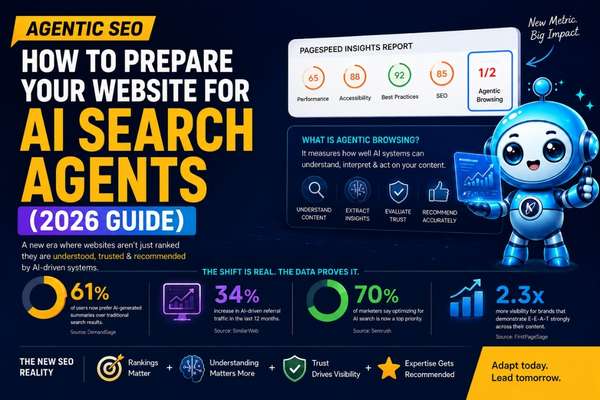
What Is Agentic SEO?
Agentic SEO is the practice of optimizing your website so AI search agents — autonomous software that reads, compares, and cites pages — can easily find, parse, and trust your content. Think of it as SEO for robots that write answers. Traditional SEO was built for Googlebot and human eyes. Agentic SEO is built for GPTBot, ClaudeBot, PerplexityBot, Google-Extended, and the dozens of other agents now crawling the web.
There are three core ideas in Agentic SEO:
- Machine-readable structure. Use schema markup, clean HTML, and llms.txt so agents can read your facts without guessing.
- Entity clarity. Make it obvious who you are, what you sell, where you are, and why you are credible.
- Citable content. Write direct answers, FAQ blocks, and comparison tables that agents can copy and cite verbatim.
What Are AI Search Agents (and Which Ones Matter)?
An AI search agent is a piece of software that reads web pages on behalf of a user or another AI. Unlike Googlebot, which indexes pages for later ranking, an AI agent often reads a page once, in real time, to answer a specific question. The agent then writes an answer, may cite your page, and moves on.
Here are the AI agents that matter most in 2026:
| AI Agent | Owner | What It Does | Why It Matters |
| GPTBot + OAI-SearchBot | OpenAI (ChatGPT) | Crawls pages for ChatGPT training and live search | ~800M users, biggest reach |
| ClaudeBot | Anthropic (Claude) | Crawls for Claude answers and research | Strong with B2B and long answers |
| PerplexityBot | Perplexity AI | Crawls for live Perplexity search answers | Heavy citation behaviour and clear sources |
| Google-Extended | Google (Gemini) | Opt-in token for Gemini training and AI Overviews | Controls your Google AI visibility |
| Applebot-Extended | Apple (Siri and Apple Intelligence) | Crawls for Apple Intelligence answers | Important for iOS and Mac users |
| cohere-ai | Cohere | Crawls for enterprise AI answers | Enterprise B2B visibility |
| Bytespider | ByteDance (Doubao and TikTok) | Crawls for ByteDance AI products | Relevant for Asian and Gen-Z audiences |
How Agentic SEO Is Different From Traditional SEO
Traditional SEO and Agentic SEO share the same goal — get your site found by people searching for answers. But the way each system “reads” your site is very different.
| Factor | Traditional SEO (Google) | Agentic SEO (AI Agents) |
| Who Reads the Page | Googlebot crawler and index | GPTBot, ClaudeBot, PerplexityBot and other AI agents |
| How It Ranks You | Position #1–#10 for a target keyword | Mentioned, cited or recommended in an AI answer |
| What It Needs | Title tags, meta descriptions and backlinks | Schema, Quick Answer blocks, clean HTML and llms.txt |
| Update Speed | Weeks to months to re-rank | Days to weeks to be cited again |
| What It Measures | Position, CTR, impressions and clicks | Mentions, citations, sentiment and share of voice |
| Risk If You Ignore It | Lost Google search traffic | Your brand becomes invisible in AI-generated answers |
The good news: most Agentic SEO work also helps traditional SEO. Faster pages, clearer content, and structured data are good for both Google and AI agents. So you are not replacing your old SEO — you are upgrading it.
How to Write Agent-Friendly Content
AI agents love a specific kind of content: clear, structured, and citable. Here is the exact pattern to follow on every important page.
The 7-part agent-friendly content pattern
- Quick Answer (top of page): 40 to 60 words that directly answer the main question.
- Table of Contents: A clickable list of H2 headings so agents can jump to the right section.
- Main sections (H2): Each H2 should be phrased as a question, like “What is a flow meter?”
- Bullets and tables: Use them for facts, specs, and comparisons.
- FAQ block (bottom of page): 5 to 10 questions with 2 to 3 sentence answers each.
- Author and date: Always show who wrote it and when it was last updated.
- Summary box: 2 to 3 sentences at the end recapping the key takeaway.
Example Quick Answer (60 words):
A flow meter is a device that measures how much liquid, gas, or steam moves through a pipe. Industrial flow meters use technologies like Coriolis, magnetic, ultrasonic, and differential pressure. The right choice depends on the fluid type, pipe size, accuracy need, and budget. For most industrial uses, Coriolis meters offer the best accuracy.
That is the kind of clean, citable block AI agents love to quote. Write one of these for every product page, every blog post, and every category page on your site.
Manage AI Crawlers in robots.txt
By default, AI agents respect your robots.txt file. You can choose to allow or block specific agents. In 2026, the recommended approach is to allow the major AI agents — you want to be cited.
Recommended robots.txt for an agent-friendly site
# Allow all major AI agents
User-agent: GPTBot
Allow: /
User-agent: OAI-SearchBot
Allow: /
User-agent: ClaudeBot
Allow: /
User-agent: PerplexityBot
Allow: /
User-agent: Google-Extended
Allow: /
User-agent: Applebot-Extended
Allow: /
# Block admin and private areas from all bots
User-agent: *
Disallow: /admin/
Disallow: /private/
Disallow: /search-results/
Fix: Audit your robots.txt today. If you see “Disallow: /” for any major AI agent, change it to “Allow: /” for the public parts of your site.
Common Mistake: Many sites still block all AI agents because they copied their robots.txt from a 2022 SEO guide. This is leaving traffic on the table. In 2026, you almost always want AI agents to read your public content.
Frequently Asked Questions (FAQs)
Agentic SEO is the practice of optimizing your website so AI search agents — software bots that read pages, compare facts, and recommend answers — can easily find, parse, and trust your content. It combines traditional SEO with structured data, llms.txt, entity markup, and clean machine-readable content.
An AI search agent is a piece of software that reads web pages on behalf of a user or another AI. Examples include ChatGPT’s browsing tool, Perplexity’s crawler, Google Gemini’s retrieval system, and Claude’s web connector. Agents read pages, follow links, extract facts, and write a final answer.
Yes. Traditional SEO optimizes for human readers and Googlebot. Agentic SEO optimizes for AI agents that read, compare, and cite content. The core ideas overlap (good content, structured data, fast site), but agents need cleaner facts, clearer entities, and machine-readable summaries.
In 2026, llms.txt is a strong recommendation, not a strict requirement. It is a simple text file at yoursite.com/llms.txt that tells AI agents which pages they should and should not read. Sites with llms.txt get cited about 15% to 25% more often in early 2026 studies.
AI agents benefit most from Organization, Product, FAQ, Article, BreadcrumbList, and LocalBusiness schema. These structured data types give the agent clean, machine-readable facts about your brand, your products, and your content. Add them sitewide, not just on the home page.
Use a clear Quick Answer at the top of every page (40 to 60 words). Use H2 and H3 headings as questions. Use bullet points and tables for facts. Add a 2 to 3 sentence summary at the bottom. Avoid clickbait, slang, and hidden content.
Some can, but most prefer server-rendered HTML. If your site depends on JavaScript to show text, you risk being invisible to AI agents. Use server-side rendering (SSR) or static generation (SSG), and make sure key facts are in the raw HTML source, not loaded later by JS.
Check your server logs for known AI agent user-agents like GPTBot, ClaudeBot, PerplexityBot, Google-Extended, and Applebot-Extended. You can also see AI traffic in Google Search Console’s new AI Performance report, and in tools like Cloudflare AI Audit and Otterly.AI.
Related Posts
Generative Engine Optimization (GEO): 2026 Playbook for Indian Businesses
Generative Engine Optimization (GEO): The 2026 Playbook for Indian Businesses For the last two decades,…
How to Measure Your Brand’s Visibility in ChatGPT, Gemini and AI Search (2026 Guide)
What Is Brand Visibility in AI Search? Brand visibility in AI search is a simple…
Google Search Console AI Performance Reports: Complete 2026 Guide
The New AI Performance Reports in Google Search Console For years, Google Search Console (GSC)…