
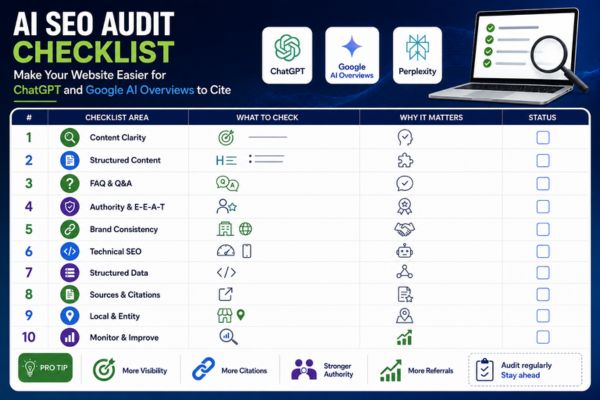
AI SEO Audit Checklist: Make Your Website Easier for ChatGPT and Google AI Overviews to Cite
A top Google ranking no longer guarantees that people will see your business in search. Users now ask questions that produce AI summaries, source links, product suggestions, and follow-up conversations instead of a page of blue links. ChatGPT and Google AI Overviews may combine information from several sources before a user visits any website.
That shift changes the audit. Your website must be crawlable, clear, useful, and trusted before an AI system can understand or cite it. Google says AI Overviews and AI Mode rely on existing Search systems, while OpenAI says public websites can appear in ChatGPT when they allow the right crawler access.
This AI SEO audit checklist helps you find gaps in technical SEO, content quality, entity signals, authority, and measurement. Google AI Overviews require pages to be indexed and eligible for normal Search snippets. ChatGPT search has separate crawler controls, including OAI-SearchBot, so visibility on one platform doesn’t guarantee visibility on another.
Make your website accessible to search crawlers and AI systems
Confirm that important pages are crawlable and indexable
Start with the pages that drive traffic, leads, sales, or trust. Check robots.txt, meta robots directives, canonical tags, XML sitemaps, HTTP status codes, redirect chains, orphan pages, and accidental noindex rules. A blocked resource, broken internal link, or conflicting canonical can stop search systems from finding or crediting the correct URL.
Compare your intended indexable page set with Google Search Console’s indexing reports and a full site crawl. Review whether important pages return a 200 status, appear in the sitemap, and receive internal links from relevant pages. Crawlability doesn’t make a page worthy of an AI citation, but it comes first.
For ChatGPT, review access for OAI-SearchBot using OpenAI’s publisher guidance. OAI-SearchBot access supports discovery and citations, while GPTBot controls potential training access. These are separate decisions.
Improve rendering, performance, and mobile access
Primary content should appear in rendered HTML, including product details, reviews, author information, navigation, and key facts. Test client-side rendering, lazy-loaded text, cookie walls, interstitials, and content hidden behind clicks or tabs. Use Google Search Console’s URL Inspection tool, rendered-page previews, and a JavaScript-enabled crawler to check what systems receive.
Review Core Web Vitals, HTTPS, responsive layouts, mobile usability, server uptime, and template consistency. Compress oversized images, remove unnecessary third-party scripts, fix layout shifts, and test forms and menus on real mobile devices. Performance alone won’t create AI visibility, but poor access can weaken search performance and user trust.
Google’s current AI Search guidance says important content should be available in textual form, crawling should be allowed, and pages should provide a good experience across devices.
Make the AI SEO Audit Checklist part of every important page
Align titles, headings, URLs, and page intent
Each priority URL should have one clear subject. The title tag, H1, URL, opening paragraph, subheadings, and supporting sections should point to the same intent. Remove vague titles, keyword-stuffed headings, duplicate pages, and pages that answer unrelated questions.
Map every key page to an audience, search intent, main entity, and desired action. Intent may involve informational research, comparison, local discovery, troubleshooting, or purchase evaluation. Two pages targeting the same question need distinct purposes, or they should be combined.
Answer important questions directly and completely
List the questions customers ask before, during, and after a decision. Place a concise answer near the top, then add context, evidence, examples, limits, and next steps. Strong pages often explain definitions, processes, eligibility rules, pricing conditions, comparisons, pros and cons, and troubleshooting steps.
Use question-based headings when they help readers scan the page. Don’t add shallow FAQ blocks only to capture question keywords. A useful page supports follow-up questions without forcing users to search again.
Structured data can reinforce meaning when it matches visible content. Review accurate uses of Organization, Person, Article, Product, Service, LocalBusiness, BreadcrumbList, Review, and FAQPage. Validate JSON-LD, author and publisher details, entity names, and visible-content matches with Google’s Rich Results Test. Schema can help interpretation and eligibility for some search features, but it doesn’t guarantee citations or AI Overview inclusion.
Build content that AI systems can trust and cite
Show first-hand experience and subject expertise
Audit author bios, bylines, reviewer details, publication dates, update dates, and editorial policies. Add evidence of real work where relevant: original research, product testing, photos, case records, professional credentials, or a clear method for gathering information.
The depth of proof should match the topic’s risk. Medical, financial, legal, and safety content needs stronger review and sourcing than a casual hobby article. Generic author pages add little value when they don’t explain a person’s relevant experience.
Support claims and remove low-value content
Check every statistic, product specification, medical statement, financial claim, legal point, and market assertion. Link claims to current, relevant sources such as government agencies, official documentation, standards bodies, research groups, or primary company sources. Never use invented quotes or unsupported data.
Remove spun text, outdated advice, near-duplicate pages, generic introductions, and programmatic URLs with little unique value. Consolidate overlapping pages, redirect obsolete URLs, and add original insight where a page remains useful. AI-assisted content needs fact-checking and review by someone qualified to edit the subject.
Strengthen the entities behind your brand
Establish consistent organization and author identity
AI systems need clear information about people, businesses, products, services, and places. Check that your brand name, description, address, phone number, URL, logo, social profiles, leadership details, and author identities match across your website and trusted third-party profiles.
Keep the About, Contact, Editorial Policy, and Author pages current and specific. Use accurate sameAs references in relevant Organization or Person schema. Correct outdated business listings, inconsistent names, and old contact details that can split your identity across the web.
Build topical coverage and credible mentions
Map your main topics, related entities, customer questions, terminology, comparisons, and missing subtopics. Build logical topic clusters with descriptive internal links, useful category pages, and a clear role for each URL. Don’t publish several pages that repeat the same answer.
Audit backlinks, industry directories, professional groups, reviews, partnerships, digital PR, and unlinked brand mentions. Relevance and editorial context matter more than raw link volume. Earn legitimate references through original research, useful tools, expert contributions, and newsworthy data. Avoid paid link schemes and manufactured mentions.
Measure AI search visibility without one ranking
Establish a baseline across search platforms
Record organic impressions, clicks, rankings, conversions, indexed pages, branded searches, referral sources, and revenue from priority topics. Segment results by page type, intent, device, location, and business goal when your data supports it.
Create a fixed set of real customer prompts. Test the same wording across Google AI Overviews, Google AI Mode where available, ChatGPT search, and conventional results. Record the date, location, language, cited pages, competitors, linked sources, and errors in how your brand appears.
Google reports AI feature traffic through Search Console data. Its current documentation also points site owners to a Generative AI performance report. ChatGPT referrals may include utm_source=chatgpt.com, which can help separate those visits in analytics.
Track citations, referrals, and business impact
Separate a brand mention from a direct citation, a clickable referral, and a conversion. Monitor priority pages, authors, products, and entities through analytics, server logs, Search Console, rank trackers, and consistent manual sampling. AI answers can vary by user, location, device, language, freshness, and conversation history.
Score audit issues by severity, affected URLs, business value, effort, and evidence of impact. Fix crawl and indexation blockers first, improve high-value pages next, then strengthen authority and entity signals. Retest after major content changes, migrations, algorithm updates, or platform changes.
Turn findings into an AI SEO action plan
Assign technical, content, and trust fixes
Use a shared audit sheet with the issue, affected URLs, owner, deadline, priority, validation method, and completion date. Mark each item as passed, needs review, or priority fix.
| Audit Area | Pass Condition |
|---|---|
| Technical Access | Crawlable, indexable, rendered, mobile-friendly, secure |
| Page Meaning | Clear intent, aligned headings, useful internal links |
| Content Trust | Expert authorship, current sources, original value |
| Entity Clarity | Consistent brand, authors, products, and business details |
| Measurement | Baseline prompts, citations, referrals, and conversions tracked |
Review and maintain the checklist
After fixes ship, inspect key URLs again, rerun the crawl, test structured data, and compare Search Console and analytics data with the baseline. Document changes so future traffic shifts have a clear cause.
Run the full AI SEO audit at least quarterly and after major site events. Review prompt results, cited sources, referral quality, conversion paths, and inaccurate brand descriptions. Assign ownership to SEO, content, development, and subject-matter teams instead of leaving the checklist with one person.
Conclusion
Readiness for ChatGPT and Google AI Overviews comes from clear technical SEO, accessible page content, strong expertise, supported claims, recognizable entities, and steady measurement. Start by making valuable pages crawlable and indexable. Then improve rendered HTML, answer real questions, validate structured data, show first-hand experience, cite reliable sources, and correct inconsistent brand information.
No checklist can guarantee inclusion in an AI-generated answer. A website that is accessible, useful, trustworthy, and easy to understand has a better chance of earning conventional rankings, AI citations, qualified referrals, and conversions. Use this audit to find the largest gaps, assign the fixes, and test the results on a regular schedule.
Related Posts
LLM SEO for Small Businesses: How to Get Cited by ChatGPT, Gemini and Perplexity
LLM SEO for Small Businesses: How to Get Cited by ChatGPT, Gemini and Perplexity Search…
Best AI SEO Tools in 2026 for GEO, AEO and AI Visibility You Can Measure
Best AI SEO Tools in 2026 for GEO, AEO and AI Visibility You Can Measure…
SEO vs GEO vs AEO vs AIO: Choose the Right Search Strategy for Your Business
SEO vs GEO vs AEO vs AIO: Choose the Right Search Strategy for Your Business…